In this article
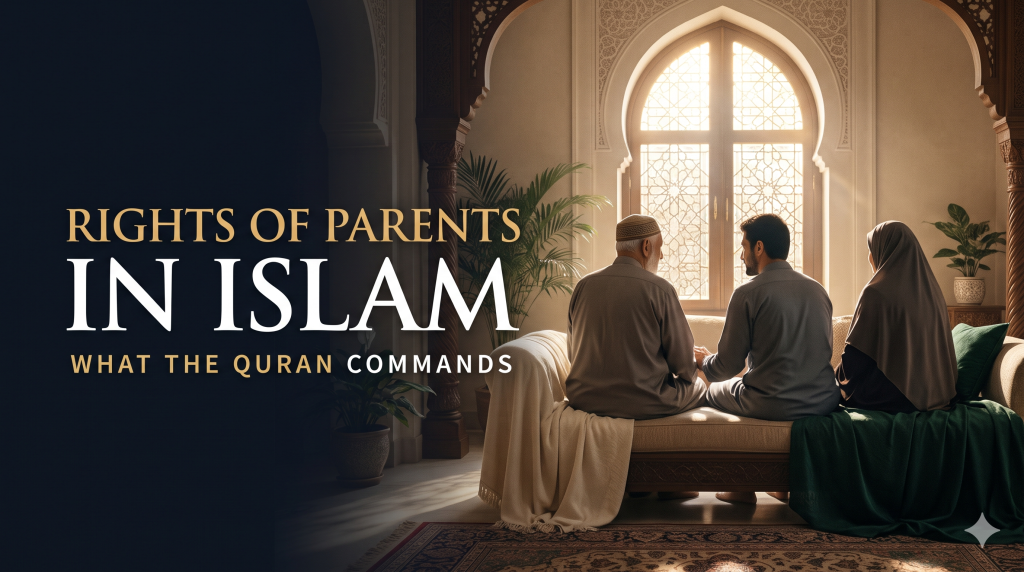
Rights of Parents in Islam: What the Quran Commands
Parents are among the greatest blessings Allah has given us. From childhood, they care for us, make sacrifices for our future, and provide love, protection, and guidance.
But what does Islam actually command us to do for our parents?
The Qur’an gives parents an exceptionally high status. In several verses, Allah mentions kindness to parents immediately after commanding people to worship Him alone. The Prophet Muhammad ﷺ also emphasised their rights and warned against being undutiful to them.
In this article, we explore the rights of parents in Islam through authentic Qur’anic verses and Sahih Hadith.
1. Allah Commands Kindness to Parents Alongside Worshipping Him
One of the strongest Qur’anic commands regarding parents appears in Surah Al-Isra.
Allah says:
Surah Al-Isra (17:23)
“Your Lord has decreed that you worship none but Him, and that you be kind to your parents. If one or both of them reach old age with you, do not say to them even ‘uff,’ nor scold them, but speak to them in noble words.”
This verse establishes the importance of treating parents with kindness and respect.
Notice that Allah does not merely prohibit physical harm. He also prohibits even an expression of irritation or contempt.
The verse teaches us to:
– Avoid speaking harshly to parents.
– Never insult or humiliate them.
– Speak with respect and gentleness.
– Show patience, especially when they become elderly.
If Islam discourages even saying a word of irritation, then deliberately hurting, insulting, or mistreating parents is even more serious.
2. Show Humility and Make Dua for Your Parents
The next verse continues the command.
Allah says:
Surah Al-Isra (17:24)
“And lower to them the wing of humility out of mercy and say: ‘My Lord, have mercy upon them as they brought me up when I was small.'”
This verse teaches two important responsibilities.
Daily Reminder
لَا يُكَلِّفُ اللَّهُ نَفْسًا إِلَّا وُسْعَهَا
Allah does not burden a soul beyond what it can bear.
अल्लाह किसी जान पर उसकी सामर्थ्य से बढ़कर बोझ नहीं डालता।
Meet trials with patience, prayer and trust in Allah’s wisdom.
First: Show humility and mercy.
As children, we depended on our parents for almost everything. When they grow older and need our support, we should treat them with patience and compassion.
Second: Pray for them.
The Qur’an teaches us a beautiful dua:
رَبِّ ارْحَمْهُمَا كَمَا رَبَّيَانِي صَغِيرًا
Transliteration: Rabbi irhamhuma kama rabbayani sagheera.
Meaning: My Lord, have mercy upon them as they brought me up when I was small.
This is a powerful Qur’anic supplication to include in our daily duas.
3. The Mother Has a Special Right to Good Companionship
Islam gives special recognition to the sacrifices of mothers.
Allah says:
Surah Luqman (31:14)
“And We have enjoined upon man [care] for his parents. His mother carried him, [increasing her] in weakness upon weakness, and his weaning is in two years. Be grateful to Me and to your parents; to Me is the final destination.”
The verse reminds us of the hardship and sacrifice a mother experiences during pregnancy, childbirth, and early childhood.
The Prophet Muhammad ﷺ also explained the mother’s special status.
Abu Hurairah (رضي الله عنه) reported:
A man came to the Messenger of Allah ﷺ and asked:
“Who is most deserving of my good companionship?”
The Prophet ﷺ replied:
“Your mother.”
The man asked, “Then who?”
He replied, “Your mother.”
The man asked again, “Then who?”
He replied, “Your mother.”
The man asked, “Then who?”
He replied, “Then your father.”
Reference: Sahih al-Bukhari 5971; Sahih Muslim 2548.
This Hadith highlights the mother’s special right to kindness and companionship, while clearly confirming the father’s important rights as well.
4. The Father Also Has an Important Right
While the mother is given special priority in good companionship, Islam does not make the father’s rights unimportant.
The Qur’an repeatedly commands kindness to both parents.
In Surah Al-Ahqaf, Allah reminds us of the hardship a mother experiences during pregnancy and childbirth, and teaches a believer to pray for gratitude and righteousness.
Surah Al-Ahqaf (46:15)
The verse also teaches us to recognise the blessings of Allah and the sacrifices of our parents.
The Prophet ﷺ placed being dutiful to parents among the greatest good deeds.
Abdullah ibn Mas’ud (رضي الله عنه) reported that he asked the Prophet ﷺ which deed was most beloved to Allah.
The Prophet ﷺ replied:
“Prayer at its proper time.”
He asked, “Then what?”
The Prophet ﷺ replied:
“Being dutiful to parents.”
Reference: Sahih al-Bukhari 527; Sahih Muslim 85.
This Hadith shows the extraordinary importance of fulfilling the rights of parents.
5. Disobedience and Mistreatment of Parents Are Major Sins
Islam does not treat disrespect towards parents as a small matter.
Abu Bakrah (رضي الله عنه) reported that the Prophet ﷺ said:
“Shall I not inform you of the greatest of the major sins?”
The companions said, “Yes, O Messenger of Allah.”
He said:
“Associating partners with Allah and disobedience to parents.”
Reference: Sahih al-Bukhari 5976; Sahih Muslim 87.
This Hadith places undutifulness to parents among the gravest major sins.
It reminds us that a person’s religious practice must also be reflected in how they treat their parents.
Praying regularly, fasting, and performing other acts of worship should not become excuses for neglecting or mistreating them.
6. What If Parents Are Non-Muslims?
Islam’s command to treat parents kindly is not limited to Muslim parents.
Allah says:
Surah Luqman (31:15)
“But if they strive to make you associate with Me that of which you have no knowledge, do not obey them, but accompany them in [this] world with appropriate kindness.”
This verse establishes an important distinction:
– A Muslim must never obey anyone in something that involves disobedience to Allah.
– Even when parents are non-Muslims or ask their child to commit an act of shirk, the child must continue treating them with kindness.
Asma bint Abi Bakr (رضي الله عنهما) asked the Prophet ﷺ about maintaining relations with her mother, who was a polytheist.
The Prophet ﷺ told her:
“Yes, maintain relations with your mother.”
Reference: Sahih al-Bukhari 5978; Sahih Muslim 1003.
This Hadith clearly demonstrates that religious differences do not cancel the responsibility to maintain kindness and family ties.
7. Caring for Parents in Their Old Age
When parents become elderly, they may need more attention, patience, financial support, and physical care.
The Qur’an specifically mentions old age in Surah Al-Isra (17:23), warning children not to express irritation or speak harshly to their parents.
The Prophet ﷺ also taught that serving one’s living parents can be an act of great devotion.
A man came to the Prophet ﷺ seeking permission to participate in a military expedition.
The Prophet ﷺ asked him:
“Are your parents alive?”
He replied, “Yes.”
The Prophet ﷺ said:
“Then strive in their service.”
Reference: Sahih al-Bukhari 3004; Sahih Muslim 2549.
This Hadith teaches that caring for parents is a serious responsibility and can be a great opportunity for earning Allah’s pleasure.
Practical ways to care for elderly parents include:
– Spend time with them and listen to them.
– Help with their medical and daily needs.
– Support them financially when they are in need and you are able.
– Avoid making them feel unwanted or burdensome.
– Treat them with patience when their health or memory becomes weaker.
8. Do We Have to Obey Parents in Everything?
Respecting parents does not mean that every instruction must be followed without exception.
The Qur’an itself explains this principle in Surah Luqman (31:15).
If parents command something that involves disobedience to Allah, such as associating partners with Him, a Muslim must not obey that command. However, the verse still requires kind and respectful companionship.
Therefore, the principle is:
Obey parents in what is right and permissible, but never obey anyone in disobedience to Allah.
Even when a child must disagree with a parent, disagreement should not become an excuse for insults, humiliation, or cruelty.
For complex family disputes, specific religious rulings should be discussed with a qualified scholar.
9. How Can We Honour Parents After Their Death?
Our responsibility to remember and honour our parents does not end when they pass away.
The Prophet ﷺ was asked whether there remained any form of dutifulness towards parents after their death.
He explained that a person can continue honouring them through:
– Praying for them.
– Seeking forgiveness for them.
– Fulfilling permissible commitments they left behind.
– Maintaining family ties that were connected to them.
– Honouring their friends.
Reference: Sahih Muslim 2552.
This Hadith reminds us that making dua for our deceased parents and maintaining family relationships are meaningful ways to continue showing them respect.
10. A Daily Dua for Parents from the Qur’an
One of the most beautiful ways to honour parents is to regularly pray for them.
Allah teaches us this supplication:
رَبِّ ارْحَمْهُمَا كَمَا رَبَّيَانِي صَغِيرًا
Transliteration: Rabbi irhamhuma kama rabbayani sagheera.
Meaning: My Lord, have mercy upon them as they brought me up when I was small.
Reference: Surah Al-Isra (17:24).
Recite this dua while remembering the care, sacrifices, and efforts your parents made for you.
Conclusion: Respecting Parents Is a Command from Allah
The Qur’an and authentic Hadith make the rights of parents clear.
Islam commands us to:
– Treat our parents with kindness and respect.
– Avoid harsh words and expressions of contempt.
– Give special attention to our mother’s sacrifices.
– Honour and care for our father.
– Support our parents when they need help.
– Maintain kindness even when parents are non-Muslims.
– Never obey a command that involves disobedience to Allah.
– Pray for our parents during their lives and after their death.
Our parents cared for us when we were unable to care for ourselves. As they grow older, we should remember their sacrifices and fulfil their rights with patience and mercy.
May Allah forgive our parents, bless those who are alive with good health, grant mercy to those who have passed away, and make us among the children who fulfil their parents’ rights. Ameen.
—
Watch More Islamic Educational Videos
Learn more about Islamic teachings through authentic Qur’anic verses and Sahih Hadith on SK Global Lens.
Next -> Rights of Husband and Wife: A Balanced View from Authentic Sources
Watch the related video: https://www.youtube.com/@skgloballens
Visit: https://skgloballens.com/
*SK Global Lens — Discover the Truth Behind Every Story.*