In this article
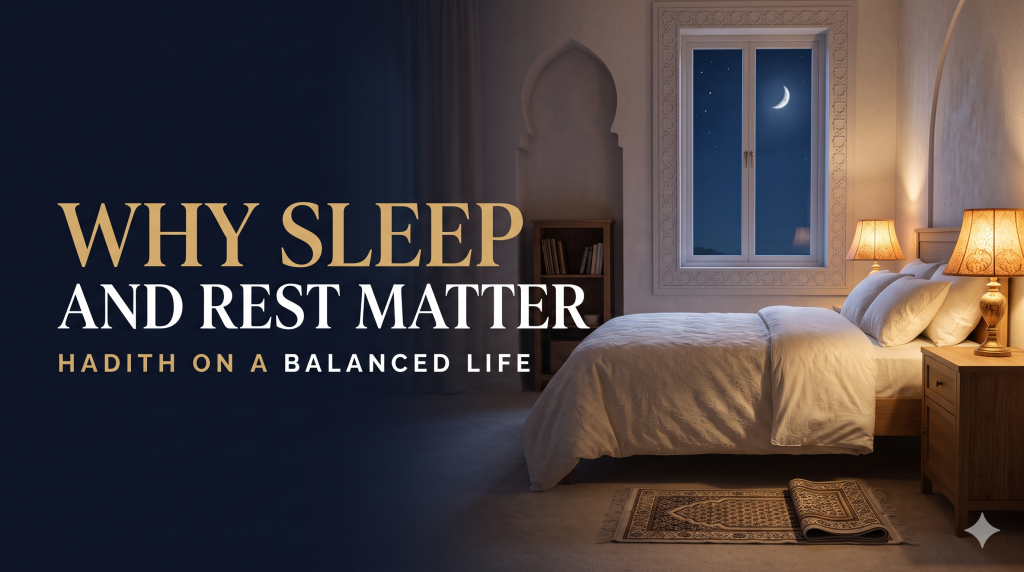
Why Sleep and Rest Matter: Hadith on a Balanced Life
In today’s busy world, many people sacrifice sleep to work longer, stay productive, use their phones, or even pursue religious activities without considering their body’s need for rest.
But does Islam teach us to ignore our physical needs in the pursuit of worship?
The answer is no.
Daily Reminder
لَا يُكَلِّفُ اللَّهُ نَفْسًا إِلَّا وُسْعَهَا
Allah does not burden a soul beyond what it can bear.
अल्लाह किसी जान पर उसकी सामर्थ्य से बढ़कर बोझ नहीं डालता।
Meet trials with patience, prayer and trust in Allah’s wisdom.
Islam teaches moderation and balance. Our bodies are a trust from Allah, and caring for them is part of living responsibly. The Qur’an describes sleep as a means of rest, while the Prophet Muhammad ﷺ clearly reminded his companions that the body has rights over a person.
Let’s explore what the Qur’an and authentic Hadith teach us about sleep, rest, worship, and a balanced life.
1. Allah Made Sleep a Means of Rest
Sleep is not an unnecessary interruption in our daily lives. It is one of the blessings Allah has provided for human beings.
Allah says in the Qur’an:
Surah Al-Furqan (25:47)
“And it is He who has made the night for you as clothing and sleep [a means for] rest and has made the day a resurrection.”
This verse reminds us that sleep is part of Allah’s design for human life. The night provides an opportunity to rest, while the day allows people to wake up, work, and seek their livelihood.
Allah also says:
Surah Ar-Rum (30:23)
“And among His signs is your sleep by night and day and your seeking of His bounty. Indeed, in that are signs for a people who listen.”
These verses invite us to reflect on the blessing of sleep and the natural rhythm of rest and activity.
2. Your Body Has a Right Over You
One of the clearest teachings about rest comes from an authentic Hadith in Sahih al-Bukhari.
Abdullah ibn Amr ibn Al-As (رضي الله عنهما) reported that the Prophet Muhammad ﷺ said:
“Your body has a right over you, your eyes have a right over you, and your wife has a right over you.”
Reference: Sahih al-Bukhari 5199
The Prophet ﷺ said this while advising Abdullah ibn Amr, who had been devoting himself to fasting during the day and praying throughout the night.
The Prophet ﷺ guided him towards a balanced routine: fast on some days and refrain on others, pray at night but also sleep.
This Hadith teaches an important principle: even acts of worship should not be approached in a way that neglects the rights of the body and other responsibilities.
A Muslim should not consider physical rest a sign of weak faith. Rest is a legitimate need that must be given its due.
3. Worship Should Be Balanced With Rest
Islam encourages worship, remembrance of Allah, prayer, fasting, and good deeds. However, it does not teach that a person should continuously exhaust themselves.
The advice given to Abdullah ibn Amr demonstrates that voluntary worship should be performed with moderation.
A person who regularly sacrifices sleep may struggle to fulfil other responsibilities, including:
– Performing daily duties properly.
– Giving time and attention to family.
– Working honestly and responsibly.
– Maintaining concentration during prayer.
– Looking after physical well-being.
The lesson is not to reduce obligatory worship. Rather, it is to avoid excessive voluntary practices that cause a person to neglect other rights and responsibilities.
4. The Prophet ﷺ Advised Sleeping When Overcome by Drowsiness
Even during prayer, the Prophet ﷺ taught his companions not to ignore overwhelming sleepiness.
Aisha (رضي الله عنها) reported that the Messenger of Allah ﷺ said:
“When anyone amongst you dozes in prayer, he should sleep until sleep goes away, for when one of you prays while he is drowsy, he may go on asking forgiveness but may actually be insulting himself.”
Reference: Sahih Muslim 786
This Hadith teaches that worship should be performed with awareness and concentration.
When severe drowsiness affects a person’s ability to understand what they are reciting, resting first is better than continuing without proper attention.
5. Following the Sunnah Before Sleeping
The Prophet Muhammad ﷺ taught practical habits for going to bed.
Sleep on the right side
Al-Bara ibn Azib (رضي الله عنه) reported that the Prophet ﷺ instructed him to perform ablution as for prayer, then lie down on his right side.
Reference: Sahih al-Bukhari 247; Sahih Muslim 2710
Clean the bed before lying down
The Prophet ﷺ instructed people to dust or clean their beds before lying down, because they do not know what may have been left on them.
Reference: Sahih al-Bukhari 6320; Sahih Muslim 2714a
Remember Allah before sleeping
The Prophet ﷺ taught supplications to recite before going to bed. One authentic supplication is:
بِاسْمِكَ اللَّهُمَّ أَمُوتُ وَأَحْيَا
Transliteration: Bismika Allahumma amootu wa ahya.
Meaning: In Your name, O Allah, I die and I live.
Reference: Sahih al-Bukhari 6324
These Sunnah practices help make bedtime an opportunity for remembrance and gratitude.
6. Sleep Is a Blessing, but Health and Time Are Also Responsibilities
The Prophet ﷺ said:
“There are two blessings that many people are deceived into losing: health and free time.”
Reference: Sahih al-Bukhari 6412
This Hadith reminds us that health and time are valuable blessings.
We should not waste our time, but neither should we neglect our health. A balanced Muslim uses time wisely for worship, work, family, rest, and beneficial activities.
Sleep should not become an excuse for laziness, and productivity should not become an excuse for neglecting necessary rest.
7. Practical Lessons for a Balanced Daily Routine
The Qur’an and Sunnah provide principles that can guide our daily habits:
1. Respect your body’s needs: Do not deliberately deprive yourself of necessary sleep without a valid reason.
2. Maintain balance in worship: Perform obligatory acts consistently and approach voluntary worship with moderation.
3. Follow the Sunnah at bedtime: Clean your bed, remember Allah, and follow the authentic supplications taught by the Prophet ﷺ.
4. Give time to your family: Personal worship and work should not lead you to neglect the rights of your family.
5. Use your waking hours wisely: Make time for work, beneficial knowledge, worship, and service to others.
6. Protect your health: Treat physical well-being as a responsibility rather than something to sacrifice unnecessarily.
Islam does not prescribe one fixed number of sleep hours for every person. Individual needs can differ according to age, health, work, and circumstances. The important principle is to maintain a routine that allows you to fulfil your obligations without harming yourself.
Conclusion: Rest Is Part of a Balanced Muslim Life
Sleep is a blessing from Allah, and the teachings of Prophet Muhammad ﷺ remind us that our bodies have rights.
The Hadith about Abdullah ibn Amr gives us a powerful lesson: worship should not become an excuse to neglect our physical needs or the rights of our families.
A balanced Muslim life includes worship, honest work, family responsibilities, beneficial activities, and sufficient rest.
Let us remember that caring for the body Allah has entrusted to us is also part of living responsibly.
May Allah grant us beneficial knowledge, good health, a balanced routine, and the ability to use our time in ways that please Him. Ameen.
—
Watch More Islamic Educational Videos
For more Islamic knowledge based on authentic Qur’anic verses and Sahih Hadith, watch our videos on SK Global Lens.
Next -> Dealing with Debt in Islam: Guidance and Duas from the Sunnah
Watch the related video: https://www.youtube.com/@skgloballens
Visit: https://skgloballens.com/
*SK Global Lens — Discover the Truth Behind Every Story.*