In this article
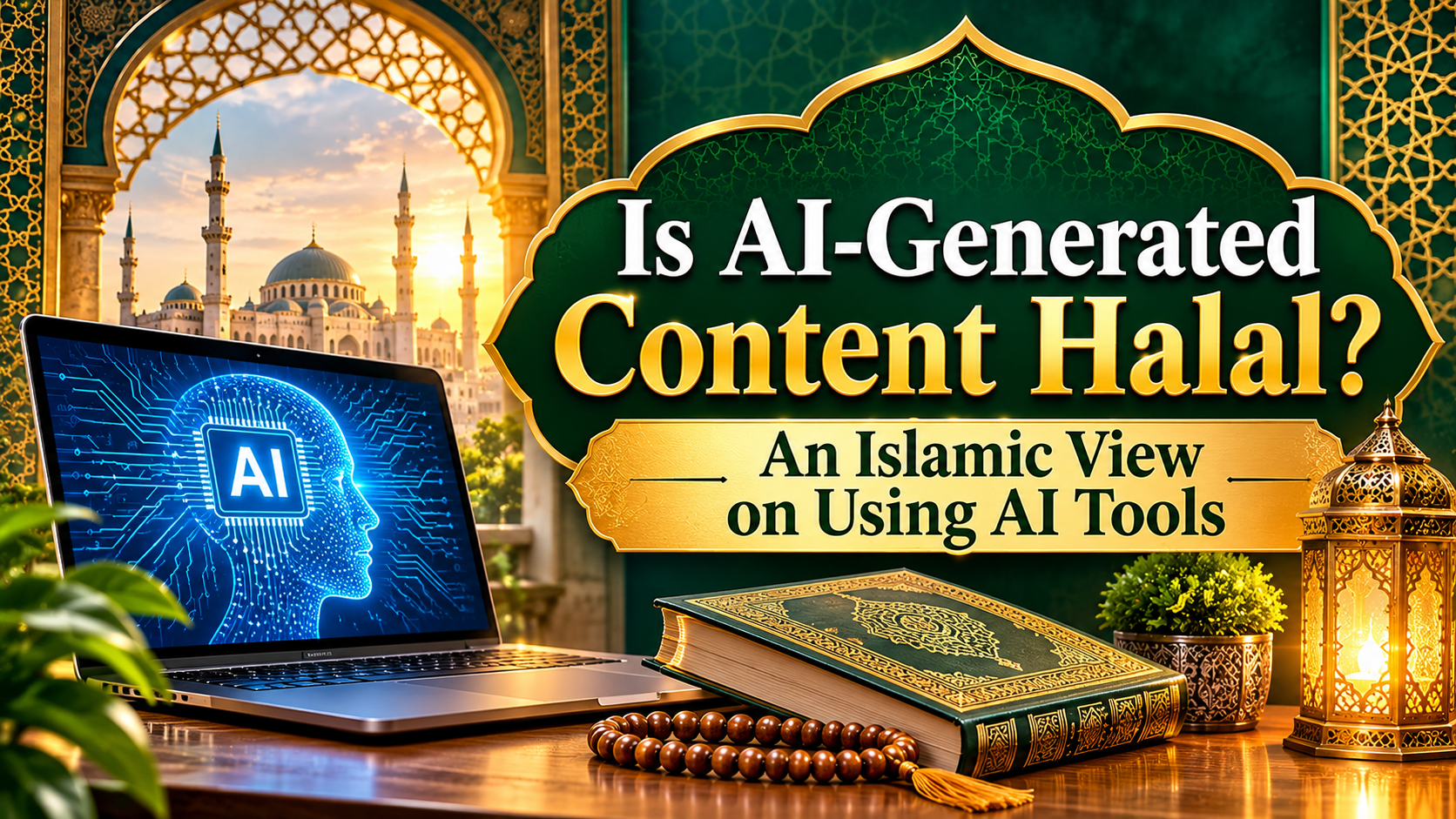
Is AI-Generated Content Halal? An Islamic View on Using AI Tools
Artificial Intelligence (AI) is changing the way people work, learn, communicate, and create content. Today, millions of people use AI tools such as ChatGPT, image generators, video editors, and writing assistants to produce articles, educational videos, graphics, presentations, and social media content.
But an important question arises for Muslims:
Is AI-generated content Halal or Haram in Islam?
Can Muslims use AI to write Islamic blog posts, create educational videos, generate images, earn money, or build online businesses? Is using AI considered cheating? What happens if AI generates incorrect information about Islam?
These are important questions in the modern digital world.
Islam provides principles that can help Muslims evaluate new technologies. Although Artificial Intelligence is not specifically mentioned in the Quran or Hadith, its use can be assessed through established Islamic principles such as honesty, beneficial knowledge, avoiding harm, respecting people’s rights, and staying away from prohibited activities.
In this article, we explore the Islamic perspective on AI-generated content, its permissible uses, potential risks, and the responsibilities of Muslims using AI tools.
1. What Is AI-Generated Content?
AI-generated content refers to material created or assisted by Artificial Intelligence software.
AI tools can produce different types of digital content, including:
– Blog articles and website content.
– Images, illustrations, and graphic designs.
– Videos and animations.
– Voiceovers and audio narration.
– Educational materials and quizzes.
– Computer code and software.
– Social media captions and advertisements.
– Research summaries and presentations.
Examples of popular AI tools include ChatGPT, Google Gemini, Microsoft Copilot, Midjourney, and other generative AI platforms.
These tools help people complete tasks more efficiently, but they do not remove the user’s responsibility for the final output.
2. Is Using AI Halal or Haram in Islam?
Using AI is generally permissible when it is used for lawful, beneficial, and honest purposes.
AI is a technology, much like a computer, camera, or calculator. Its permissibility depends largely on how it is used and what it produces.
For example:
Generally permissible uses:
– Writing educational articles.
– Learning new skills.
– Creating useful Islamic educational content.
– Designing websites for lawful businesses.
– Translating educational material.
– Creating original artwork without prohibited elements.
– Developing software that benefits society.
– Improving productivity through automation.
Potentially prohibited uses:
– Creating fake news or deliberate misinformation.
– Producing fraudulent documents.
– Generating defamatory or harmful content.
– Creating deceptive impersonations.
– Stealing copyrighted work or violating others’ rights.
– Promoting gambling, fraud, or prohibited products.
– Fabricating Quranic verses or Hadith references.
The important distinction is that the technology itself is not necessarily the problem. The purpose, content, and method of use matter.
This is a general application of Islamic principles, not a claim that every AI-related activity has received a specific scholarly ruling.
3. What Does the Quran Teach About Using Technology Responsibly?
Although the Quran does not specifically discuss Artificial Intelligence, it provides guidance on honesty, knowledge, responsibility, and avoiding harm.
These principles are relevant when using modern technology.
A. Always Verify Information
AI tools can sometimes generate incorrect information, invented references, or misleading explanations.
Muslims should not blindly accept everything produced by AI.
Allah says:
“O you who have believed, if there comes to you a disobedient one with information, investigate, lest you harm a people out of ignorance and become, over what you have done, regretful.”
Surah Al-Hujurat (49:6)
This verse teaches the importance of verifying information before accepting or sharing it.
When using AI for Islamic content, verify Quranic verses, Hadith references, translations, and religious explanations through reliable sources.
B. Do Not Spread False Information
AI can make misinformation appear professional and convincing.
A beautifully designed image, realistic voice, or well-written article does not automatically make its information true.
Allah says:
“And do not pursue that of which you have no knowledge. Indeed, the hearing, the sight and the heart – about all those [one] will be questioned.”
Surah Al-Isra (17:36)
Muslims should avoid sharing information they have not properly checked.
C. Seek Beneficial Knowledge
Islam encourages learning and acquiring knowledge that benefits individuals and society.
The first revealed verses of the Quran begin with the command:
“Read in the name of your Lord who created.”
Surah Al-Alaq (96:1)
AI can help people understand complex subjects, learn languages, develop professional skills, and access educational information.
However, AI should support learning rather than replace critical thinking and genuine understanding.
D. Do Not Cooperate in Sin
AI tools should not be used to facilitate wrongdoing.
Allah says:
“And cooperate in righteousness and piety, but do not cooperate in sin and aggression.”
Surah Al-Ma’idah (5:2)
This principle applies to AI-generated content as well. Muslims should use technology to support beneficial activities rather than harmful or prohibited ones.
4. Is It Halal to Use ChatGPT for Writing Blog Posts?
Many bloggers, website owners, students, and content creators use ChatGPT to generate articles and improve their writing.
In general, using AI as a writing assistant can be permissible when:
1. The subject is lawful.
2. The information is accurate and verified.
3. The content does not intentionally deceive readers.
4. Other people’s intellectual property and rights are respected.
5. The work meets the requirements of any agreement or platform policy.
6. The content does not promote prohibited activities.
For example, using ChatGPT to prepare an educational article about Islamic manners, the Five Pillars of Islam, or the importance of charity can be a beneficial use of technology.
However, publishing AI-generated Islamic articles without checking Quranic verses and Hadith references is irresponsible.
Important: AI should assist in preparing educational material, not act as an independent authority issuing Fatwas or interpreting complex Islamic rulings.
5. Is AI-Generated Islamic Content Halal?
Creating Islamic educational content using AI can be permissible if it is accurate, respectful, and based on authentic Islamic sources.
Muslims can use AI to help create:
– Islamic blog articles.
– Quran and Hadith educational summaries.
– Islamic quizzes.
– Educational videos.
– Islamic history presentations.
– Dua explanations.
– Ramadan educational content.
– Infographics about Islamic teachings.
However, extra care is necessary when producing religious material.
Important Rules for Creating Islamic Content with AI
1. Verify Quranic References
Always check the original Arabic verse, Surah number, Ayah number, and translation.
2. Verify Hadith Authenticity
Do not publish a Hadith simply because AI provides a reference. Check its source and grading through reliable Hadith collections and qualified scholars.
3. Never Invent Religious Teachings
AI-generated statements must never be presented as Quranic verses, authentic Hadith, or established Islamic rulings without verification.
4. Respect Prophets and Sacred Figures
Avoid disrespectful, misleading, or inappropriate depictions of Prophets and other sacred figures.
5. Avoid Sensational Religious Claims
Do not create misleading headlines such as “Allah Guarantees Wealth If You Do This” without authentic evidence.
6. Make Corrections When Errors Are Discovered
If an Islamic article contains an incorrect reference or explanation, correct it promptly.
The purpose of Islamic content should be education and guidance, not merely attracting clicks and generating revenue.
6. Is Creating AI-Generated Images Halal?
AI image generators allow users to create illustrations, thumbnails, posters, educational graphics, and realistic digital artwork.
The Islamic ruling on images and depictions is a subject of scholarly discussion, particularly regarding images of living beings.
Some scholars distinguish between photography, digital images, drawings, and three-dimensional representations, while others take more restrictive positions.
Therefore, it would be inaccurate to declare every AI-generated image automatically Halal or Haram.
Some practical considerations include:
– Avoid inappropriate, indecent, or sexually explicit imagery.
– Do not create deceptive images intended to damage someone’s reputation.
– Do not impersonate real people or fabricate endorsements.
– Respect people’s privacy and consent.
– Avoid disrespectful depictions of Prophets and sacred personalities.
– Consider scholarly guidance on depictions of living beings.
– Respect copyright, licensing, and intellectual property rights.
For Islamic educational websites, symbolic imagery such as architecture, geometric patterns, landscapes, books, lanterns, and calligraphy can be useful design choices.
7. Is Earning Money Through AI-Generated Content Halal?
Another important question concerns earning money through AI.
Can Muslims earn through AI-written blogs, YouTube videos, digital products, graphic design, and online services?
Generally, earning through AI-assisted work can be permissible when the underlying activity, product, service, and business arrangement are lawful.
Some examples include:
AI-Assisted Blogging
Writing informative articles using AI assistance and earning through permissible advertisements or affiliate marketing can be acceptable.
AI Video Creation
Creating educational, informative, and beneficial videos using AI-generated visuals and voiceovers can be permissible.
AI Graphic Design
Offering lawful graphic design services using AI tools can be a legitimate source of income.
AI-Assisted Software Development
Building websites, applications, and useful software with AI assistance can be permissible.
AI Digital Products
Creating templates, educational resources, presentations, and digital downloads can provide lawful income when the products and selling methods are permissible.
However, AI does not make an otherwise prohibited business permissible.
For example, using AI to create sophisticated advertisements for gambling services does not change the underlying nature of the activity.
Similarly, fake reviews, plagiarised articles, misleading product claims, and fraudulent digital products remain problematic even if AI creates them.
8. Is Using AI Considered Cheating?
Using AI is not automatically cheating.
The answer depends on the context and the rules governing the activity.
For example:
– Using AI to understand a difficult programming concept is generally a learning aid.
– Using AI to improve grammar in a blog post is a writing aid.
– Using AI to generate ideas for a business is a productivity tool.
– Submitting AI-generated academic work as entirely independent work when the institution prohibits it can constitute dishonesty.
– Using AI to fabricate qualifications, experience, or professional achievements is deceptive.
Islam places great importance on honesty and fulfilling agreements.
Prophet Muhammad ﷺ said:
“Whoever deceives us is not one of us.”
Reference: Sahih Muslim 102.
Therefore, Muslims should be transparent when disclosure is required and should never use AI to misrepresent their knowledge, work, or qualifications.
9. Can AI Replace Islamic Scholars and Muftis?
No. AI should not be treated as a replacement for qualified Islamic scholars.
AI can help users locate information, summarise educational material, explain basic terminology, and identify relevant Quranic verses and Hadith.
However, it has important limitations:
– It can generate fabricated religious references.
– It may misunderstand Arabic terminology.
– It may overlook differences among Islamic schools of thought.
– It may provide outdated or incomplete information.
– It does not possess the authority of a qualified Mufti.
– It cannot independently establish a valid Islamic Fatwa.
For complex matters involving marriage, divorce, inheritance, financial contracts, Islamic investments, and other religious rulings, Muslims should consult qualified scholars.
AI can be a research assistant, but religious authority requires proper Islamic knowledge and scholarly qualifications.
10. Seven Rules Muslims Should Follow When Using AI Tools
Here are seven practical rules for using AI responsibly according to Islamic values:
1. Choose a Halal Purpose: Use AI for lawful and beneficial activities.
2. Verify Information: Check facts before publishing or sharing them.
3. Maintain Honesty: Never use AI to deceive people.
4. Respect Others’ Rights: Avoid plagiarism, impersonation, and privacy violations.
5. Protect Religious Accuracy: Verify Quranic verses, Hadith, and Islamic rulings.
6. Avoid Harmful Content: Do not create material that promotes sin, exploitation, or injustice.
7. Remain Responsible: Take responsibility for the content you publish, even when AI helped create it.
These principles help Muslims benefit from modern technology without compromising their religious and ethical responsibilities.
11. AI and the Future of Muslims in the Digital World
Artificial Intelligence is becoming an important part of education, business, healthcare, software development, research, and communication.
Muslims should not automatically reject every new technology, nor should they accept every technological development without considering its consequences.
Instead, they should approach AI with knowledge, responsibility, and Islamic values.
AI can help Muslims:
– Learn and teach useful knowledge.
– Create educational resources.
– Improve professional skills.
– Develop lawful businesses.
– Make information more accessible.
– Support charitable and community projects.
– Spread authentic Islamic teachings.
The real challenge is not simply whether AI is powerful. It is whether people use that power responsibly.
Technology should serve humanity and beneficial purposes rather than become a tool for deception, exploitation, or misinformation.
Frequently Asked Questions (FAQs)
1. Is AI-generated content Halal in Islam?
AI-generated content can be permissible when its purpose, subject, production method, and use comply with Islamic principles. Content involving deception, prohibited activities, or harm may be impermissible.
2. Is using ChatGPT Halal or Haram?
Using ChatGPT for learning, writing, programming, research, and other permissible purposes is generally acceptable. Its use becomes problematic when it facilitates prohibited activities, dishonesty, or harm.
3. Can Muslims use AI to write Islamic articles?
Yes, Muslims can use AI as a writing and research assistant for Islamic educational articles. However, Quranic verses, Hadith references, translations, and religious explanations must be carefully verified.
4. Can Muslims earn money from AI-generated YouTube videos?
AI-assisted YouTube content can be a permissible source of income when the content, production methods, advertisements, and monetisation arrangements comply with Islamic principles.
5. Is AI-generated art Halal?
Scholars have differing views regarding images of living beings and digital representations. The content, purpose, depiction, and applicable scholarly opinion should be considered.
6. Can AI give Islamic Fatwas?
AI should not be treated as an independent authority for issuing Islamic Fatwas. Muslims should consult qualified scholars for religious rulings, especially on complex matters.
7. Is publishing AI-written content without mentioning AI Haram?
Not automatically. Whether disclosure is required depends on the circumstances, contractual obligations, platform rules, and whether readers are being misled. Honesty should always be maintained.
8. What is the biggest Islamic concern about AI?
Some major concerns include misinformation, deception, privacy violations, copyright infringement, harmful content, and presenting unverified religious information as authentic Islamic knowledge.
Conclusion
Artificial Intelligence is a powerful modern tool, and like other technologies, it can be used for beneficial or harmful purposes.
From an Islamic perspective, the important question is not simply whether content was created by a human or an AI tool. What matters is whether its purpose, content, methods, and consequences comply with Islamic principles.
Muslims can use AI for education, research, writing, design, programming, and lawful business activities while maintaining honesty, accuracy, and responsibility.
When creating Islamic content, special care must be taken to verify Quranic verses, authentic Hadith, and religious explanations. AI should support the spread of beneficial knowledge, not replace qualified scholars.
The guiding principle is simple: Use technology for good, remain honest, avoid harm, and never compromise your faith for convenience or profit.
May Allah guide us to use modern technology in beneficial ways, protect us from misinformation and wrongdoing, and grant us knowledge that benefits humanity. Ameen.
Continue Learning with SK Global Lens
Explore more authentic Islamic knowledge, Quranic teachings, Islamic lifestyle guides, daily Duas, Sunnah practices, and educational articles at SK Global Lens.
Learn Islam through authentic references from the Holy Quran and Sahih Hadith.