In this article
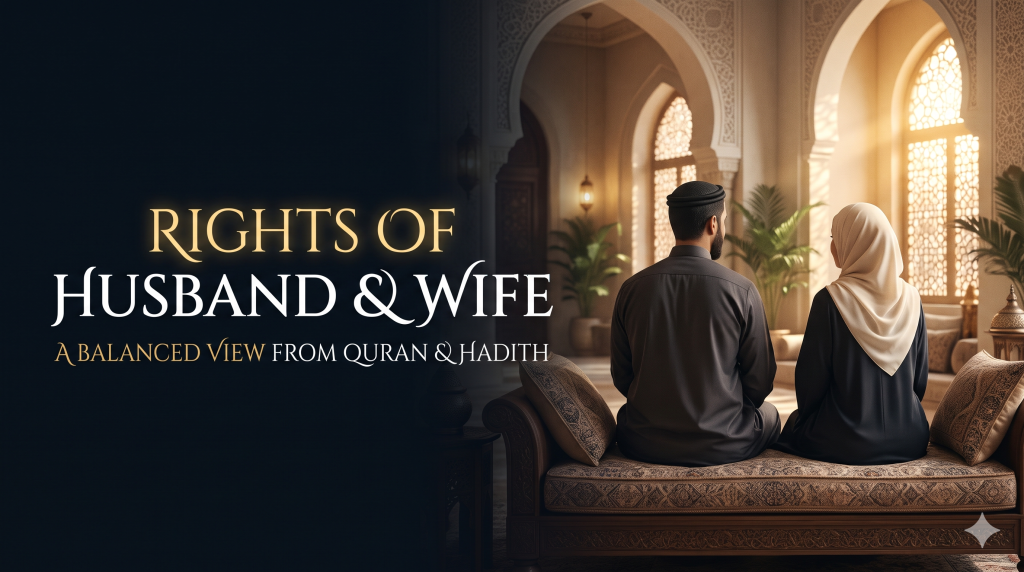
Rights of Husband and Wife in Islam: A Balanced View from the Quran and Authentic Hadith
Marriage in Islam is more than a social relationship. It is a sacred commitment built upon faith, love, mercy, responsibility, trust, and mutual respect.
Islam gives both husband and wife important rights and responsibilities. A successful Muslim marriage is not based on one person demanding their rights while ignoring the responsibilities they owe to the other.
The Holy Quran and authentic Hadith provide guidance on how spouses should treat one another, fulfil their obligations, resolve disagreements, and build a peaceful family.
Unfortunately, many marital problems arise when people learn only about the rights of one spouse while overlooking the rights of the other.
This article explores the rights of husbands and wives in Islam through authentic Quranic verses and Hadith references, presenting a balanced understanding of Islamic marriage.
Daily Reminder
لَا يُكَلِّفُ اللَّهُ نَفْسًا إِلَّا وُسْعَهَا
Allah does not burden a soul beyond what it can bear.
अल्लाह किसी जान पर उसकी सामर्थ्य से बढ़कर बोझ नहीं डालता।
Meet trials with patience, prayer and trust in Allah’s wisdom.
1. The Purpose of Marriage in Islam
Allah describes marriage as one of His signs and a source of tranquillity, affection, and mercy.
Allah says:
“And of His signs is that He created for you from yourselves mates that you may find tranquillity in them; and He placed between you affection and mercy.”
Source: Surah Ar-Rum (30:21)
This verse establishes three important foundations of marriage:
– Tranquillity (Sakinah): Spouses should find peace and comfort with one another.
– Love (Mawaddah): Husband and wife should show genuine affection.
– Mercy (Rahmah): They should treat one another with compassion, especially during difficult times.
Marriage should not become a relationship of domination, fear, or constant conflict. Its purpose includes creating a peaceful and supportive family environment.
2. Rights of a Wife in Islam
Islam gives a wife several important rights that her husband must respect.
A. The Right to Mahr (Marriage Gift)
Mahr is a financial gift that the husband is obligated to give his wife as part of the marriage contract.
Allah says:
“And give the women [upon marriage] their [bridal] gifts graciously.”
Source: Surah An-Nisa (4:4)
Important points:
– Mahr belongs exclusively to the wife.
– The husband cannot simply take it back.
– The amount should be mutually agreed upon.
– The wife has the right to receive her agreed Mahr.
Mahr is the wife’s right, not a payment for purchasing her or her consent to mistreatment.
B. The Right to Financial Maintenance
A husband is responsible for providing appropriate financial maintenance for his wife according to his means and Islamic principles.
This generally includes:
– Food.
– Clothing.
– Suitable accommodation.
– Necessary living expenses.
Allah says:
“Upon the father is the mothers’ provision and their clothing according to what is acceptable.”
Source: Surah Al-Baqarah (2:233)
This verse addresses the financial responsibility in the context of breastfeeding and child care.
The Prophet Muhammad ﷺ also explained the wife’s right to food and clothing in a reasonable manner.
Source: Sahih Muslim 1218a.
A wife is not automatically required to use her personal wealth to maintain the household. Her own financial property remains hers.
C. The Right to Kindness and Respect
A husband must treat his wife with kindness, dignity, and respect.
Allah says:
“And live with them in kindness.”
Source: Surah An-Nisa (4:19)
This means a husband should:
– Speak respectfully.
– Avoid humiliation and insults.
– Appreciate his wife’s efforts.
– Be patient with ordinary human mistakes.
– Treat her with compassion.
The Prophet Muhammad ﷺ said:
“The best of you are those who are best to their wives.”
Source: Jami’ at-Tirmidhi 3895 (graded Sahih by Darussalam).
This Hadith makes good treatment of one’s wife an important measure of good character.
D. The Right to Safety and Dignity
A wife has the right to live with dignity and without oppression.
The Prophet Muhammad ﷺ repeatedly instructed men to treat women well.
In his Farewell Pilgrimage address, he reminded the believers:
“Fear Allah concerning women!”
Source: Sahih Muslim 1218a.
Marriage does not give a husband permission to abuse, threaten, humiliate, or unjustly harm his wife.
Physical and emotional abuse should never be normalised as acceptable marital behaviour.
E. The Right to Her Own Wealth and Property
A Muslim woman has independent ownership of her wealth and property.
Her Mahr, inheritance, salary, savings, and other lawful personal assets belong to her.
A husband cannot simply take her money without her consent or a valid legal basis.
Quranic references: Surah An-Nisa (4:4), (4:7), and (4:32).
3. Rights of a Husband in Islam
Just as a wife has rights, a husband also has rights that should be respected within the boundaries of Islamic teachings.
A. The Right to Marital Cooperation
Marriage requires cooperation, trust, and mutual consideration.
Both spouses should make sincere efforts to fulfil their marital responsibilities and protect the relationship.
A wife should respect her husband and cooperate with him in matters that are lawful and reasonable.
This cooperation should not be confused with obeying someone in wrongdoing or accepting injustice.
B. The Right to Faithfulness and Protection of Marital Trust
Both husband and wife are expected to remain faithful and protect the trust of marriage.
The Quran instructs believers to protect their chastity and maintain moral boundaries.
Source: Surah Al-Mu’minun (23:5–7).
A husband and wife should avoid behaviour that damages trust, honour, or the security of their marriage.
C. The Right to Respect and Good Conduct
A husband deserves respectful treatment, just as a wife does.
Both should avoid:
– Insulting one another.
– Publicly humiliating one another.
– Sharing private marital matters unnecessarily.
– Constant criticism and disrespect.
– Deliberately creating distrust.
Respect should be mutual rather than demanded by only one spouse.
D. The Right to Marital Intimacy
Physical intimacy is an important part of marriage and is a right of both spouses.
Both should consider one another’s needs, feelings, health, and circumstances.
Marital intimacy should be approached with kindness, mutual consideration, and respect, not force or humiliation.
The Prophet Muhammad ﷺ taught that a wife has rights over her husband, including the right not to be neglected because of excessive voluntary worship.
Source: Sahih al-Bukhari 5199.
4. Responsibilities of a Husband Towards His Wife
A husband is not only responsible for earning money. He must also fulfil his duties as a husband and family leader.
Important responsibilities include:
1. Providing appropriate financial maintenance according to his means.
2. Paying the agreed Mahr.
3. Treating his wife with kindness.
4. Protecting her dignity and safety.
5. Respecting her lawful personal property.
6. Giving attention to her emotional and marital needs.
7. Being fair and responsible in family decisions.
8. Avoiding oppression, cruelty, and neglect.
Allah says:
“Men are caretakers of women because Allah has given one more responsibility than the other and because they spend from their wealth.”
Source: Surah An-Nisa (4:34).
This verse discusses Qiwamah, commonly understood in Islamic scholarship as responsibility and guardianship within the family, including financial responsibility.
It should not be used as a justification for tyranny, cruelty, or ignoring the wife’s rights.
5. Responsibilities of a Wife Towards Her Husband
A wife also has responsibilities that contribute to a healthy Muslim marriage.
These include:
1. Maintaining marital faithfulness and trust.
2. Respecting her husband.
3. Cooperating in lawful and reasonable family matters.
4. Protecting the privacy of the marriage.
5. Taking care of shared family responsibilities through mutual understanding.
6. Considering her husband’s rights and emotional needs.
7. Avoiding dishonesty, humiliation, and deliberate harm.
The Prophet Muhammad ﷺ taught that a woman is responsible for her husband’s household and children.
Source: Sahih al-Bukhari 893; Sahih Muslim 1829.
This Hadith highlights responsibility and trust within the family.
It should not be used to justify neglecting a wife’s rights or placing an unreasonable burden upon her.
The detailed legal obligations regarding domestic work and household duties have been discussed differently by Islamic scholars and schools of jurisprudence. Couples should approach these matters with fairness and mutual understanding.
6. Both Husband and Wife Have Rights Over Each Other
One of the most important Quranic principles concerning marital rights appears in Surah Al-Baqarah.
Allah says:
“And due to the wives is similar to what is expected of them, according to what is reasonable.”
Source: Surah Al-Baqarah (2:228).
This verse establishes the principle that women have rights corresponding to the responsibilities expected of them, according to what is fair and reasonable.
A healthy marriage requires both spouses to fulfil their responsibilities rather than constantly focusing on what they should receive.
The Prophet Muhammad ﷺ also demonstrated this principle through his own behaviour.
He helped his family with household tasks, and when asked about his conduct at home, Aishah (RA) explained that he would serve his family.
Source: Sahih al-Bukhari 676.
This teaches us that helping one’s wife is not beneath a husband. It is part of good character and following the example of Prophet Muhammad ﷺ.
7. How Should Husband and Wife Resolve Disagreements?
Disagreements can occur in any marriage. Islam provides guidance for resolving conflicts fairly and responsibly.
Allah says:
“And if you fear dissension between the two, send an arbitrator from his people and an arbitrator from her people. If they both desire reconciliation, Allah will cause it between them.”
Source: Surah An-Nisa (4:35).
This verse teaches an important approach to resolving serious marital disputes.
Practical steps include:
– Discuss problems calmly.
– Listen to one another.
– Avoid insults and threats.
– Do not involve outsiders unnecessarily.
– Seek advice from trustworthy and knowledgeable people.
– Consider fair mediation when problems become serious.
– Prioritise reconciliation when it is safe and appropriate.
Where abuse or danger exists, protecting the affected spouse and seeking appropriate professional and legal help must take priority.
8. What Did Prophet Muhammad ﷺ Teach About Treating Wives?
The Prophet Muhammad ﷺ was the best example of kindness and good conduct.
He said:
“A believing man should not hate a believing woman; if he dislikes one of her characteristics, he will be pleased with another.”
Source: Sahih Muslim 1468b.
This Hadith teaches spouses not to judge each other only by their shortcomings.
Instead, they should recognise positive qualities, practise patience, and appreciate one another.
In another Hadith, the Prophet ﷺ said:
“The best of you is the best to his wives.”
Source: Jami’ at-Tirmidhi 3895.
These teachings remind us that good character should begin at home.
9. A Beautiful Quranic Dua for Husband, Wife, and Family
Allah teaches believers a beautiful supplication for their spouses and children.
Arabic:
رَبَّنَا هَبْ لَنَا مِنْ أَزْوَاجِنَا وَذُرِّيَّاتِنَا قُرَّةَ أَعْيُنٍ وَاجْعَلْنَا لِلْمُتَّقِينَ إِمَامًا
Transliteration:
Rabbana hab lana min azwajina wa dhurriyyatina qurrata a’yunin waj’alna lil-muttaqeena imama.
Meaning:
“Our Lord, grant us from among our spouses and offspring comfort to our eyes and make us an example for the righteous.”
Source: Surah Al-Furqan (25:74).
This Dua asks Allah for a righteous family, peaceful relationships, and children who become a source of comfort and goodness.
Husband and wife can include this supplication in their daily prayers.
10. The Real Meaning of a Successful Muslim Marriage
A successful marriage is not one in which only the husband is obeyed or only the wife receives attention.
It is a relationship in which both understand their responsibilities and respect one another’s rights.
A good Muslim husband should be:
– Responsible.
– Kind.
– Fair.
– Supportive.
– Respectful.
A good Muslim wife should be:
– Trustworthy.
– Respectful.
– Supportive.
– Faithful.
– Considerate.
Both should strive to become better Muslims and better companions for one another.
Remember that marriage is an Amanah (trust) from Allah, and both spouses will be accountable for how they fulfil their responsibilities.
Final Thoughts
Islam provides a balanced framework for marriage based on rights, responsibilities, kindness, justice, and mutual respect.
A husband should not demand his rights while neglecting his wife’s rights. Similarly, a wife should not overlook her husband’s lawful rights and responsibilities.
The Quran and authentic Sunnah teach us that a peaceful marriage is built through love, mercy, patience, cooperation, and good character.
May Allah bless every husband and wife with understanding, patience, love, mercy, and a peaceful family life.
May He protect our marriages from injustice, cruelty, and misunderstandings and guide us to fulfil the rights of one another.
Ameen.
—
SK Global Lens – Discover the Truth Behind Every Story.
Next -> Rights of Parents in Islam: What the Quran Commands
Watch the related video: https://www.youtube.com/@skgloballens
Visit: https://skgloballens.com/
Follow SK Global Lens for authentic Islamic knowledge based on the Holy Quran and Sahih Hadith.