In this article
The Six Articles of Faith (Iman): What Muslims Believe
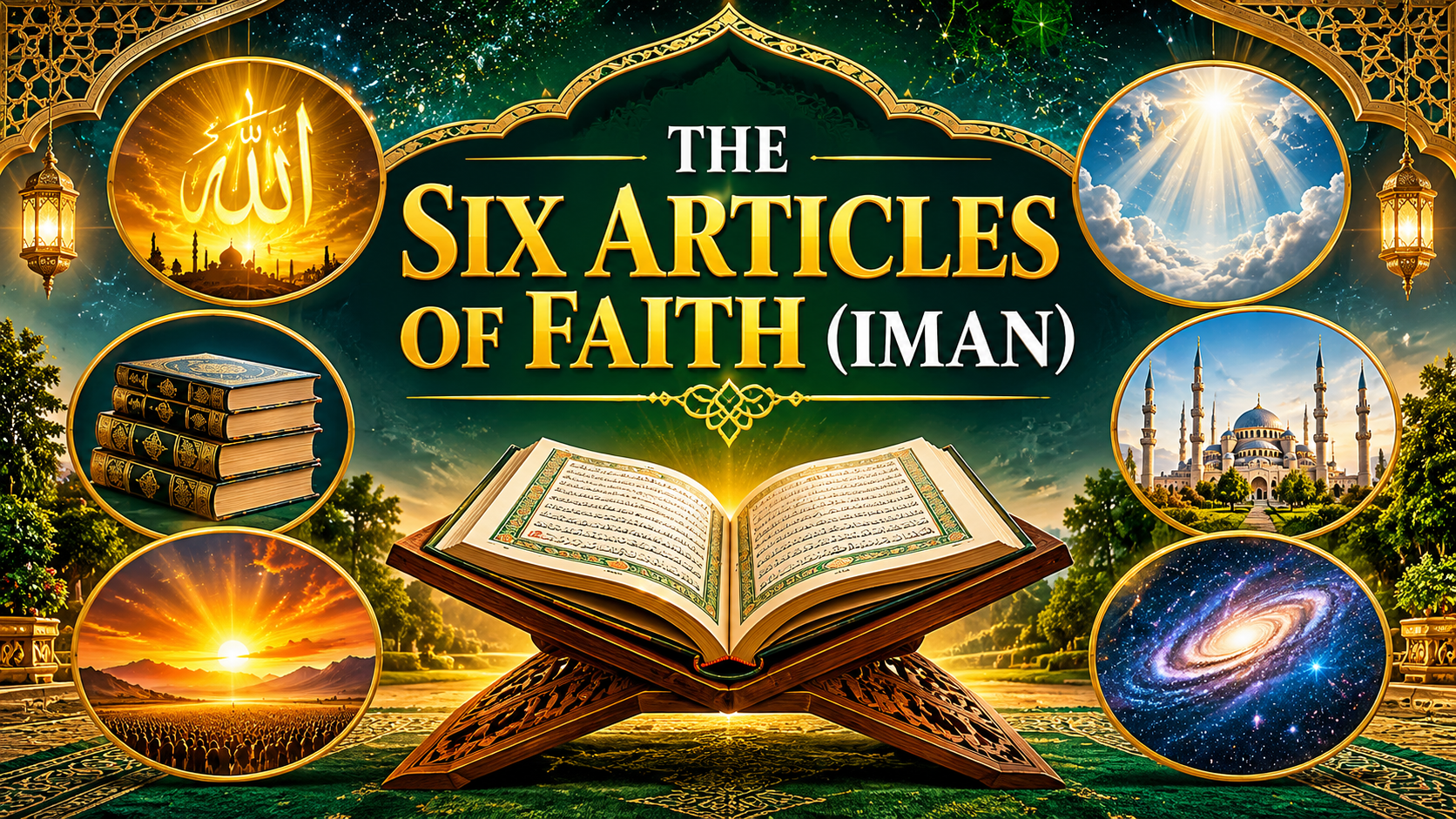
The Six Articles of Faith (Iman) are the fundamental beliefs that form the foundation of Islam. Every Muslim is expected to believe in Allah, His angels, His revealed books, His messengers, the Last Day, and divine decree (Qadar), including its good and its difficult aspects.
These six beliefs are essential to understanding Islamic faith. They guide Muslims in their relationship with Allah, their understanding of life, and their preparation for the Hereafter.
In this article, we will explore each of the six articles of Iman, their meanings, and their importance according to the Holy Quran and authentic Hadith.
What Is Iman in Islam?
Iman is the Arabic word for faith or belief. In Islam, it means having sincere belief in the heart, affirming the truth, and living according to that belief.
The six articles of faith are clearly explained in the famous Hadith of Angel Jibreel (Gabriel), who came to Prophet Muhammad ﷺ and asked him about Iman.
The Prophet Muhammad ﷺ replied:
“To believe in Allah, His angels, His books, His messengers, the Last Day, and to believe in divine decree (Qadar), both its good and its bad.”
Reference: Sahih Muslim 8a.
These six beliefs form the foundation of Islamic Aqeedah (creed).
1. Belief in Allah (Tawheed)
The first and most important article of faith is believing in Allah, the One and Only God.
Muslims believe that Allah is the Creator, Sustainer, and Owner of everything in the universe. He has no partners, no children, and no equal. He alone deserves worship.
Belief in Allah includes accepting His existence, His Oneness, His beautiful names and attributes, and His absolute power and knowledge.
The foundation of this belief is Tawheed, which means the Oneness of Allah.
What Muslims Believe About Allah:
– Allah is the only Creator and Sustainer.
– He has no partner or equal.
– He is All-Knowing and All-Powerful.
– He hears every prayer and knows what is hidden in the hearts.
– He alone deserves worship and complete obedience.
Quranic Reference:
“Say, He is Allah, [who is] One. Allah, the Eternal Refuge. He neither begets nor is born, Nor is there to Him any equivalent.”
Surah Al-Ikhlas (112:1–4)
This Surah beautifully explains the absolute Oneness of Allah.
2. Belief in Angels (Mala’ikah)
The second article of faith is believing in the angels created by Allah.
Angels are beings created by Allah from light. They are invisible to human eyes in their original form and always obey Allah’s commands. They do not disobey Him.
Muslims believe that angels have different responsibilities assigned to them by Allah.
Some Well-Known Angels in Islam:
– Jibreel (Gabriel): Responsible for bringing revelation from Allah to His messengers.
– Mika’il (Michael): Associated with responsibilities involving rain and provision by Allah’s command.
– Israfeel: Will blow the Trumpet by Allah’s command on the Day of Judgment.
– Malak al-Mawt: The Angel of Death, responsible for taking souls by Allah’s command.
– Kiraman Katibin: Angels who record human deeds.
Quranic Reference:
“Whoever is an enemy to Allah and His angels and His messengers and Gabriel and Michael – then indeed, Allah is an enemy to the disbelievers.”
Surah Al-Baqarah (2:98)
Belief in angels reminds Muslims that Allah’s creation is much greater than what human beings can see.
3. Belief in the Revealed Books (Kutub)
The third article of faith is believing in the divine books revealed by Allah to guide humanity.
Muslims believe that Allah sent revelations through His messengers to teach people about His Oneness, morality, worship, and the purpose of life.
The four well-known revealed scriptures mentioned in Islamic teachings are:
– Tawrat (Torah): Revealed to Prophet Musa (Moses), peace be upon him.
– Zabur (Psalms): Revealed to Prophet Dawud (David), peace be upon him.
– Injil (Gospel): Revealed to Prophet Isa (Jesus), peace be upon him.
– The Holy Quran: Revealed to Prophet Muhammad ﷺ.
Muslims believe in all genuine revelations sent by Allah. The Quran is the final divine revelation, revealed as guidance for all humanity.
Quranic Reference:
“The Messenger has believed in what was revealed to him from his Lord, and [so have] the believers. All of them have believed in Allah and His angels and His books and His messengers…”
Surah Al-Baqarah (2:285)
The Quran is preserved as the final revelation and serves as the primary source of guidance for Muslims.
4. Belief in the Messengers (Rusul)
The fourth article of faith is believing in all the prophets and messengers sent by Allah.
Muslims believe that Allah selected special individuals to deliver His message and guide people towards the right path.
All prophets taught the worship of one God and called people towards righteousness.
Some prophets mentioned in the Holy Quran include:
– Adam (AS)
– Nuh (Noah) (AS)
– Ibrahim (Abraham) (AS)
– Musa (Moses) (AS)
– Dawud (David) (AS)
– Sulaiman (Solomon) (AS)
– Isa (Jesus) (AS)
– Muhammad ﷺ
Muslims believe that Prophet Muhammad ﷺ is the final prophet and messenger of Allah. No prophet will come after him.
Quranic Reference:
“Muhammad is not the father of [any] one of your men, but [he is] the Messenger of Allah and last of the prophets.”
Surah Al-Ahzab (33:40)
Believing in all the messengers means respecting them and accepting the truth of their messages without rejecting any of Allah’s prophets.
5. Belief in the Last Day (Yawm al-Akhirah)
The fifth article of faith is believing in the Day of Judgment, also known as Yawm al-Qiyamah.
Muslims believe that this worldly life is temporary and that every human being will eventually return to Allah.
On the Day of Judgment, all people will be resurrected and held accountable for their deeds. Allah will judge everyone with perfect justice.
Important Events Associated with the Last Day:
– The end of the present world.
– The blowing of the Trumpet.
– The resurrection of human beings.
– The gathering of all people for judgment.
– The presentation and weighing of deeds.
– Accountability for actions and intentions.
– The final destination of Paradise (Jannah) or Hellfire (Jahannam), according to Allah’s judgment.
Quranic Reference:
“Every soul will taste death, and you will only be given your [full] compensation on the Day of Resurrection.”
Surah Aal-e-Imran (3:185)
Belief in the Hereafter encourages Muslims to live responsibly, avoid wrongdoing, seek forgiveness, and perform good deeds.
6. Belief in Divine Decree (Qadar)
The sixth article of faith is believing in Qadar, which means divine decree or destiny.
Muslims believe that everything happens within Allah’s knowledge, wisdom, and decree. Allah knows everything that has happened, is happening, and will happen.
Belief in Qadar includes four important aspects:
1. Knowledge: Allah has complete knowledge of everything.
2. Writing: Allah has recorded what will happen in the Preserved Tablet (Al-Lawh Al-Mahfuz).
3. Will: Nothing happens outside Allah’s will and permission.
4. Creation: Allah is the Creator of everything.
However, believing in destiny does not mean that human beings have no responsibility for their actions. Islam teaches that people make choices and are accountable for them.
Muslims are encouraged to work hard, make good decisions, pray to Allah, and trust His wisdom.
Quranic Reference:
“Indeed, all things We created with predestination.”
Surah Al-Qamar (54:49)
Belief in Qadar teaches patience during difficulties, gratitude during blessings, and trust in Allah in every situation.
Why Are the Six Articles of Faith Important?
The six articles of Iman are not simply beliefs to memorise. They shape a Muslim’s character, decisions, and daily life.
Here are some important benefits of having strong Iman:
1. Strengthens the relationship with Allah: Belief in Allah encourages sincere worship and dependence on Him.
2. Develops good character: Belief in accountability motivates Muslims to act honestly and responsibly.
3. Creates patience: Belief in Qadar helps Muslims remain patient during difficult times.
4. Encourages good deeds: Belief in the Last Day reminds people that their actions matter.
5. Provides spiritual peace: Trust in Allah gives believers hope and reassurance.
6. Strengthens Islamic identity: Understanding Iman helps Muslims remain connected to their faith and teachings.
Frequently Asked Questions (FAQs)
1. What are the six articles of faith in Islam?
The six articles of faith are:
– Belief in Allah.
– Belief in angels.
– Belief in revealed books.
– Belief in messengers.
– Belief in the Last Day.
– Belief in divine decree (Qadar).
2. Which Hadith explains the six articles of Iman?
The famous Hadith of Angel Jibreel explains the six articles of Iman. It is recorded in Sahih Muslim, Hadith 8a.
3. What is the difference between Iman and Islam?
Iman primarily refers to faith and belief, while Islam refers to submission to Allah through the teachings and practices of the religion. Both are closely connected and are essential to a Muslim’s religious life.
4. Are the six articles of faith mentioned in the Quran?
Yes. Surah Al-Baqarah (2:285) mentions belief in Allah, His angels, His books, and His messengers. Other Quranic verses establish belief in the Last Day and divine decree. The complete six-part formulation is explicitly explained in the Hadith of Jibreel.
5. Why must Muslims believe in all the prophets?
All prophets were chosen by Allah to deliver His guidance. Muslims must believe in all of them and cannot accept some while rejecting others.
6. Does belief in Qadar mean that everything is already decided?
Allah has complete knowledge and decree over everything. However, human beings still make choices and are responsible for their actions. Muslims should make sincere efforts, choose what is right, and trust Allah.
Conclusion
The Six Articles of Faith are the foundation of a Muslim’s belief and understanding