In this article
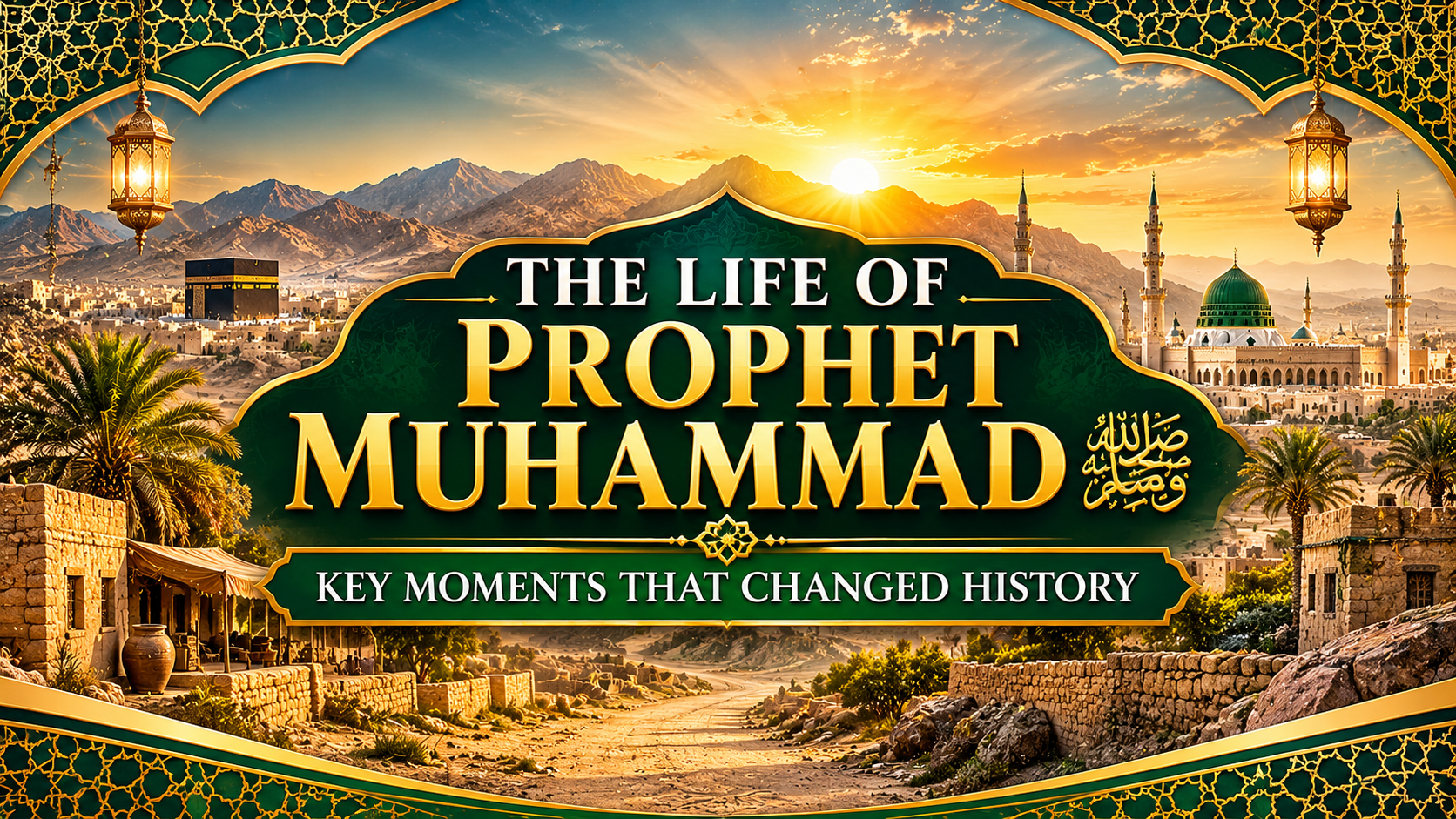
The Life of Prophet Muhammad (PBUH): Key Moments That Changed History
Prophet Muhammad ﷺ is the final Messenger of Allah and the central figure of Islam. His life is an extraordinary example of faith, patience, mercy, honesty, leadership, and devotion to Allah.
Born in Makkah in the 6th century, Prophet Muhammad ﷺ grew up as an orphan, became known for his honesty and trustworthy character, and received the first revelation of the Holy Quran at the age of 40.
Over the next 23 years, he delivered Allah’s message, faced persecution, migrated to Madinah, established the first Muslim community, and guided people towards the worship of one God.
His teachings transformed Arabian society and continue to guide more than a billion Muslims around the world.
In this article, we explore the major events in the life of Prophet Muhammad ﷺ and the important lessons Muslims can learn from his remarkable journey.
1. Birth of Prophet Muhammad ﷺ in Makkah (Around 570 CE)
Prophet Muhammad ﷺ was born in Makkah, in the Arabian Peninsula, around 570 CE, traditionally associated with the Year of the Elephant.
His father, Abdullah ibn Abdul Muttalib, passed away before his birth. His mother was Aminah bint Wahb.
He belonged to the respected Banu Hashim family of the Quraysh tribe.
His birth took place during a period when many people in Arabia worshipped idols and tribal traditions played a major role in society.
Even before his prophethood, Allah had destined him for a special mission: delivering the final message of Islam to humanity.
2. Childhood and Life as an Orphan
Prophet Muhammad ﷺ experienced the difficulties of losing loved ones at a very young age.
His mother, Aminah, passed away when he was approximately six years old. After her death, his grandfather, Abdul Muttalib, took responsibility for him.
Two years later, his grandfather also passed away.
He was then placed under the care and protection of his uncle, Abu Talib.
Despite facing these hardships, Prophet Muhammad ﷺ grew up with patience, dignity, and excellent character.
Quranic Reference:
“Did He not find you an orphan and give you shelter?”
Surah Ad-Duha (93:6)
This verse reminds believers of Allah’s care and protection for His Messenger ﷺ during his early life.
3. His Honesty and Trustworthy Character
Before receiving revelation, Prophet Muhammad ﷺ was widely respected for his honesty and integrity.
People in Makkah called him Al-Amin, meaning “The Trustworthy,” and As-Sadiq, meaning “The Truthful.”
He was known for keeping promises, dealing fairly with people, and maintaining a reputation for honesty.
His character earned him the trust of people even before he began preaching Islam.
One important example was his role in resolving a dispute when the Quraysh rebuilt the Kaaba. He suggested a fair solution for placing the Black Stone (Hajar al-Aswad), preventing conflict among the tribes.
His life teaches Muslims that honesty and good character are essential qualities of a believer.
4. Marriage to Khadijah (RA)
At approximately 25 years of age, Prophet Muhammad ﷺ married Khadijah bint Khuwaylid (RA), a respected businesswoman of Makkah.
She was known for her intelligence, dignity, and strong character.
Their marriage was built on love, respect, and mutual support.
Khadijah (RA) became his greatest supporter during the early days of his prophethood. When he received the first revelation and returned home deeply shaken, she comforted him and reassured him.
She was also the first person to believe in his message.
Their relationship remains an important example of loyalty, respect, and support within marriage.
5. The First Revelation in the Cave of Hira (610 CE)
One of the most important moments in Islamic history occurred when Prophet Muhammad ﷺ was approximately 40 years old.
He regularly spent time in the Cave of Hira, near Makkah, reflecting and worshipping Allah.
During one of these occasions, Angel Jibreel (AS) came to him with the first revelation from Allah.
The first revealed verses were from Surah Al-Alaq:
“Read in the name of your Lord who created.”
Surah Al-Alaq (96:1–5)
This event marked the beginning of his prophethood and the revelation of the Holy Quran.
The first revelation was a turning point in human history and the beginning of a 23-year period of divine guidance.
Hadith Reference: Sahih al-Bukhari 3.
6. Beginning of the Message of Islam
After receiving the first revelation, Prophet Muhammad ﷺ began inviting people towards Islam.
Initially, he shared the message privately with his family and close companions.
Among the earliest believers were:
– Khadijah bint Khuwaylid (RA)
– Abu Bakr As-Siddiq (RA)
– Ali ibn Abi Talib (RA)
– Zayd ibn Harithah (RA)
The central message was simple but powerful:
– Worship Allah alone.
– Reject idol worship.
– Believe in the Hereafter.
– Speak the truth.
– Help the poor and needy.
– Treat people with justice and kindness.
After the initial period of private preaching, Prophet Muhammad ﷺ began publicly inviting people to Islam.
7. Opposition and Persecution in Makkah
As Islam began spreading, several powerful leaders of the Quraysh opposed Prophet Muhammad ﷺ and his followers.
The message of worshipping one God challenged the established religious and social practices of Makkah.
Early Muslims faced insults, threats, social pressure, and physical persecution.
Some believers were tortured because they refused to abandon their faith.
Despite these difficulties, Prophet Muhammad ﷺ continued delivering Allah’s message with patience and determination.
He encouraged his followers to remain firm in their belief and trust Allah.
His perseverance teaches Muslims that standing for truth sometimes requires great courage and sacrifice.
8. Migration of Muslims to Abyssinia
Due to increasing persecution in Makkah, Prophet Muhammad ﷺ allowed some of his followers to migrate to Abyssinia (modern-day Ethiopia).
The ruler of Abyssinia, known as the Negus (Najashi), was a Christian king.
The Muslims sought protection there because they believed they would be treated fairly.
This migration demonstrated that Islam values justice and peaceful coexistence.
It also showed the importance of protecting religious freedom and human dignity.
9. The Year of Sorrow (619 CE)
One of the most difficult periods in the life of Prophet Muhammad ﷺ was known as the Year of Sorrow.
During this period, he lost two of his greatest supporters:
– His beloved wife, Khadijah (RA).
– His uncle and protector, Abu Talib.
Khadijah (RA) had supported him emotionally and financially, while Abu Talib had protected him from the hostility of the Quraysh.
Their deaths brought immense sadness and additional challenges.
However, Prophet Muhammad ﷺ did not abandon his mission.
He continued calling people towards Islam with patience and trust in Allah.
This period teaches Muslims the importance of patience during grief and hardship.
10. The Journey to Taif
After facing increasing opposition in Makkah, Prophet Muhammad ﷺ travelled to Taif to invite its people towards Islam.
However, the response was extremely hostile. He was rejected and subjected to physical abuse.
Despite this painful experience, he did not seek revenge.
Instead, he remained hopeful and prayed for guidance for the people.
His response demonstrates extraordinary patience, mercy, and forgiveness.
This incident is one of the most powerful examples of his compassionate character.
11. Al-Isra and Al-Miraj: The Night Journey and Ascension
Another significant event in the life of Prophet Muhammad ﷺ was Al-Isra and Al-Miraj.
According to Islamic belief, Allah took His Messenger ﷺ on a miraculous night journey from Masjid al-Haram in Makkah to Al-Masjid al-Aqsa in Jerusalem.
From there, he was taken through the heavens by Allah’s command.
This miraculous event is associated with the establishment of the five daily prayers as an obligation for Muslims.
Quranic Reference:
“Exalted is He who took His Servant by night from al-Masjid al-Haram to al-Masjid al-Aqsa…”
Surah Al-Isra (17:1)
The event reminds Muslims of the importance of Salah and the special connection between worship and faith.
12. The Hijrah: Migration from Makkah to Madinah (622 CE)
As opposition in Makkah continued, Prophet Muhammad ﷺ and his followers eventually migrated to Madinah, then known as Yathrib.
This historic migration is called the Hijrah.
During the journey, Prophet Muhammad ﷺ was accompanied by Abu Bakr As-Siddiq (RA).
They stayed in the Cave of Thawr while avoiding those searching for them.
Eventually, they safely reached Madinah, where the local Muslims, known as the Ansar, welcomed them warmly.
The Hijrah marked a major turning point in Islamic history.
The Islamic calendar begins from this historic migration.
Quranic Reference:
“If you do not aid the Prophet – Allah has already aided him when those who disbelieved had driven him out…”
Surah At-Tawbah (9:40)
13. Establishment of the Muslim Community in Madinah
After arriving in Madinah, Prophet Muhammad ﷺ began establishing a strong and organised Muslim community.
One of his first major actions was the construction of Masjid an-Nabawi, which became a centre for prayer, education, consultation, and community life.
He also established brotherhood between the Muhajirun (Muslims who migrated from Makkah) and the Ansar (Muslims of Madinah).
This helped create unity, mutual support, and a sense of responsibility among believers.
Prophet Muhammad ﷺ also established agreements to organise relations among the different communities living in Madinah.
His leadership demonstrated the importance of justice, cooperation, and social responsibility.
14. The Battle of Badr (624 CE)
The Battle of Badr was the first major battle between the Muslims of Madinah and the Quraysh of Makkah.
The Muslim army numbered approximately 313, while the opposing force was significantly larger.
Despite their numerical disadvantage, the Muslims achieved victory.
The Battle of Badr became a major event in Islamic history and strengthened the faith of the early Muslim community.
Quranic Reference:
“And Allah had already given you victory at Badr while you were few in number…”
Surah Aal-e-Imran (3:123)
This event teaches Muslims about faith, patience, discipline, and reliance upon Allah.
15. The Battle of Uhud (625 CE)
The Battle of Uhud took place near Mount Uhud, outside Madinah.
During this battle, the Muslims faced the Quraysh army.
Initially, the Muslims gained an advantage, but a group of archers left their assigned positions despite the Prophet’s ﷺ instructions.
This changed the course of the battle, and the Muslims suffered significant losses.
The Prophet Muhammad ﷺ himself was injured, and many companions were martyred, including Hamza ibn Abdul Muttalib (RA).
The Quran discusses important lessons from this event, including obedience, patience, and perseverance.
Quranic Reference: Surah Aal-e-Imran (3:152).
16. The Battle of the Trench (627 CE)
The Battle of the Trench, also known as Ghazwat al-Khandaq, was another important event in Islamic history.
A large coalition of opposing forces advanced towards Madinah.
Following the suggestion of Salman al-Farsi (RA), the Muslims dug a trench around vulnerable parts of the city as a defensive strategy.
This innovative approach helped protect Madinah from the attacking forces.
The opposing coalition eventually withdrew without achieving its objective.
This event demonstrates the importance of teamwork, strategic thinking, patience, and consultation.
Quranic Reference: Surah Al-Ahzab (33:9–10).
17. The Treaty of Hudaybiyyah (628 CE)
The Treaty of Hudaybiyyah was an important peace agreement between Prophet Muhammad ﷺ and the Quraysh of Makkah.
The Muslims had travelled towards Makkah intending to perform Umrah but were prevented from entering the city.
After negotiations, both sides agreed to a peace treaty.
Although some of its conditions initially appeared difficult for the Muslims, the agreement created an opportunity for peaceful communication and the spread of Islam.
The Quran describes this event as a clear victory.
Quranic Reference:
“Indeed, We have given you a clear conquest.”
Surah Al-Fath (48:1)
The treaty teaches the importance of patience, diplomacy, fulfilling agreements, and seeking peaceful solutions.
18. The Conquest of Makkah (630 CE)
One of the most remarkable events in the life of Prophet Muhammad ﷺ was the Conquest of Makkah.
After the treaty was violated by the allies of the Quraysh, Prophet Muhammad ﷺ led the Muslim forces towards Makkah.
The city came under Muslim control with limited fighting.
At a moment when he had the power to take revenge against those who had persecuted him and his followers, Prophet Muhammad ﷺ demonstrated mercy and forgiveness.
He granted a broad amnesty to the people of Makkah.
The Kaaba was cleansed of idols, restoring it as a centre of worship dedicated to Allah alone.
This event remains a powerful example of humility, forgiveness, and restraint.
19. The Battle of Hunayn and the Later Years
After the Conquest of Makkah, the Muslim community faced another major conflict at Hunayn.
The battle initially brought difficulty for the Muslim forces, but they eventually regrouped and achieved victory.
In the following years, Islam continued spreading throughout Arabia.
Delegations from different tribes visited Madinah to meet Prophet Muhammad ﷺ and learn about Islam.
These years were important in establishing the Muslim community and spreading Islamic teachings.
20. The Farewell Pilgrimage (632 CE)
In the tenth year after the Hijrah, Prophet Muhammad ﷺ performed his Farewell Hajj.
Thousands of Muslims accompanied him to Makkah.
During this pilgrimage, he delivered an important sermon at Arafat, reminding Muslims about their responsibilities and the principles of Islam.
Among the major teachings emphasised in his final pilgrimage were:
– The sanctity of human life and property.
– The importance of justice.
– The rights and proper treatment of women.
– Brotherhood among Muslims.
– Avoiding oppression and wrongdoing.
– Holding firmly to Allah’s guidance.
One important Quranic verse revealed during this period states:
“Today I have perfected for you your religion and completed My favour upon you and have approved for you Islam as religion.”
Surah Al-Ma’idah (5:3)
The Farewell Pilgrimage remains a defining moment in Islamic history.
21. The Passing of Prophet Muhammad ﷺ (632 CE)
After returning to Madinah from the Farewell Pilgrimage, Prophet Muhammad ﷺ became ill.
His final days were spent in Madinah, where he remained surrounded by his family and companions.
He passed away in 632 CE at approximately 63 years of age.
His death brought profound sadness to the Muslim community.
Abu Bakr As-Siddiq (RA) later reminded the people that while Prophet Muhammad ﷺ had passed away, Allah remains Ever-Living and Eternal.
The Prophet ﷺ was buried in the chamber of Aisha (RA), where his resting place remains beside Masjid an-Nabawi.
Although his earthly life ended, his teachings, Sunnah, and message continue to guide Muslims across the world.
Important Lessons from the Life of Prophet Muhammad ﷺ
The Seerah (biography) of Prophet Muhammad ﷺ is not simply a record of historical events. It provides practical lessons for everyday life.
Here are ten important lessons Muslims can learn from his life:
1. Honesty: Always speak the truth and fulfil your promises.
2. Patience: Remain steadfast during difficult circumstances.
3. Mercy: Treat others with kindness and compassion.
4. Forgiveness: Avoid unnecessary revenge and forgive when possible.
5. Humility: Never allow power or success to create arrogance.
6. Trust in Allah: Place your faith in Allah while making sincere efforts.
7. Justice: Treat people fairly, regardless of their background.
8. Family Values: Show love, respect, and responsibility towards family members.
9. Charity: Help the poor, needy, and vulnerable.
10. Good Character: Make kindness, honesty, and integrity part of everyday life.
Frequently Asked Questions (FAQs)
1. When was Prophet Muhammad ﷺ born?
Prophet Muhammad ﷺ was born in Makkah around 570 CE, traditionally known as the Year of the Elephant. The exact Gregorian date is not established with certainty.
2. At what age did Prophet Muhammad ﷺ receive the first revelation?
He received the first revelation at approximately 40 years of age in the Cave of Hira.
3. Who was the first person to accept Islam?
Khadijah bint Khuwaylid (RA), his wife, was the first person to believe in his prophethood.
4. How many years did Prophet Muhammad ﷺ preach Islam?
His prophetic mission lasted approximately 23 years: around 13 years in Makkah and 10 years in Madinah.
5. Why did Prophet Muhammad ﷺ migrate to Madinah?
He migrated because of increasing persecution and opposition in Makkah and the invitation and support offered by the people of Madinah.
6. What was the Hijrah?
The Hijrah was the migration of Prophet Muhammad ﷺ and the early Muslims from Makkah to Madinah in 622 CE. It marks the beginning of the Islamic calendar.
7. When did Prophet Muhammad ﷺ pass away?
Prophet Muhammad ﷺ passed away in Madinah in 632 CE, at approximately 63 years of age.
8. What is the most important lesson from the life of Prophet Muhammad ﷺ?
His life teaches Muslims to worship Allah alone, maintain excellent character, show mercy, remain patient, uphold justice, and follow the guidance of the Quran and Sunnah.
Conclusion
The life of Prophet Muhammad ﷺ is a timeless example of faith, courage, patience, mercy, and devotion to Allah.
From his childhood as an orphan in Makkah to his final days in Madinah, every stage of his life offers valuable lessons for humanity.
He faced persecution without abandoning his mission, showed forgiveness when he had the power to take revenge, and treated people with compassion and fairness.
For Muslims, learning about the Seerah is not simply about understanding Islamic history. It is about discovering how to apply the Prophet’s ﷺ teachings in everyday life.
May Allah grant us the ability to understand the Seerah, follow the Sunnah of Prophet Muhammad ﷺ, and develop the excellent character that he taught. Ameen.
Continue Learning with SK Global Lens
Explore more authentic Islamic knowledge, Quranic teachings, stories of the Prophets, daily Duas, Sunnah practices, and Islamic quizzes at SK Global Lens.
Learn Islam through authentic references from the Holy Quran and Sahih Hadith.