In this article
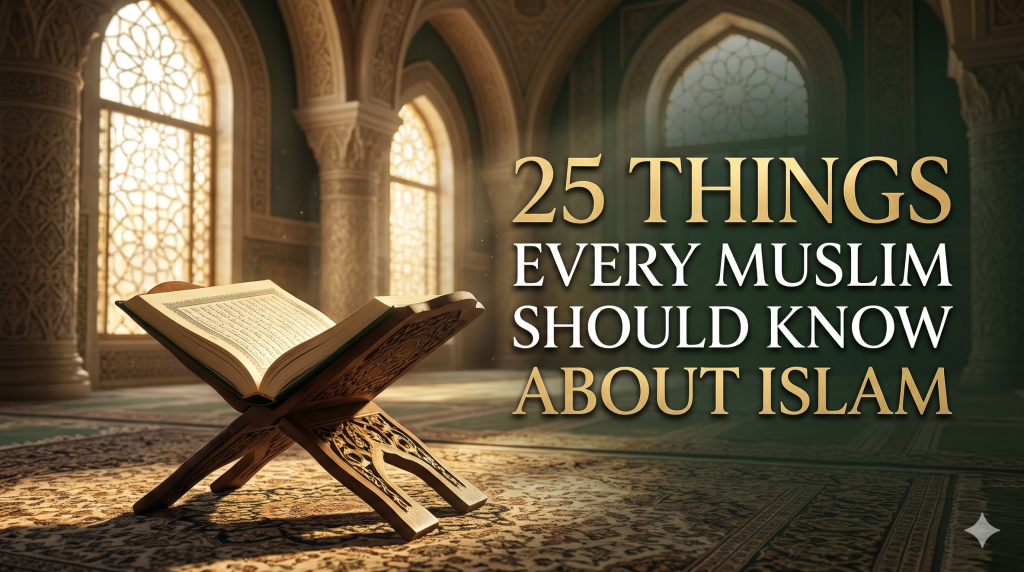
25 Things Every Muslim Should Know About Islam
Introduction
Islam is more than a religion; it is a complete way of life that teaches humanity how to worship Allah, treat others with kindness, maintain good character, and prepare for the Hereafter.
Whether you were born into a Muslim family, recently embraced Islam, or simply want to strengthen your Islamic knowledge, understanding the fundamentals of Islam is essential.
The Qur’an and the Sunnah of Prophet Muhammad ﷺ provide guidance for every aspect of life, from worship and family relationships to business, honesty, charity, and personal conduct.
Here are 25 important things every Muslim should know about Islam, explained in simple language with references from the Qur’an and authentic Hadith.
— Every answer includes a Quran or Sahih Hadith reference for further learning.
Is this statement true?
Deeds are judged by intentions
Prayer may be neglected when life is busy
Charity decreases a person’s wealth
1. Allah Is the One and Only God
The foundation of Islam is Tawheed (the Oneness of Allah).
Muslims believe that Allah is the only Creator, Sustainer, and One worthy of worship. He has no partners, children, or equals.
Allah says in the Qur’an:
“Say, He is Allah, the One. Allah, the Eternal Refuge. He neither begets nor is born, nor is there to Him any equivalent.”
Reference: Surah Al-Ikhlas (112:1–4)
2. Prophet Muhammad ﷺ Is the Final Messenger
Muslims believe that Prophet Muhammad ﷺ is the final messenger sent by Allah to guide humanity.
He was sent with the final divine message, the Qur’an, and his life provides an example of faith, patience, honesty, mercy, and excellent character.
Allah says:
“Muhammad is not the father of any of your men, but is the Messenger of Allah and the seal of the prophets.”
Reference: Surah Al-Ahzab (33:40)
3. The Qur’an Is the Final Divine Revelation
The Qur’an is the holy book of Islam, revealed by Allah to Prophet Muhammad ﷺ through Angel Jibreel (Gabriel).
It contains guidance about faith, worship, morality, family, justice, and the purpose of human existence.
Muslims believe that the Qur’an is Allah’s preserved final revelation.
Reference: Surah Al-Hijr (15:9)
4. Islam Has Five Pillars
The Five Pillars are the foundation of Islamic practice:
1. Shahadah: Declaration of faith.
2. Salah: Performing the five daily prayers.
3. Zakat: Giving obligatory charity when eligible.
4. Sawm: Fasting during Ramadan.
5. Hajj: Pilgrimage to Makkah at least once in a lifetime, if physically and financially able.
Prophet Muhammad ﷺ explained that Islam is built upon these five pillars.
Reference: Sahih al-Bukhari 8; Sahih Muslim 16c.
5. There Are Six Articles of Faith (Iman)
Every Muslim should understand the six fundamental beliefs of Iman:
1. Belief in Allah.
2. Belief in His angels.
3. Belief in His revealed books.
4. Belief in His messengers.
5. Belief in the Last Day.
6. Belief in divine decree (Qadr), including its good and difficult aspects.
These beliefs are explained in the famous Hadith of Jibreel.
Reference: Sahih Muslim 8a.
6. Muslims Must Pray Five Times a Day
Salah is one of the most important acts of worship in Islam.
The five obligatory prayers are:
– Fajr – Before sunrise.
– Dhuhr – After midday.
– Asr – Afternoon.
– Maghrib – Just after sunset.
– Isha – Night.
Prayer connects a Muslim with Allah and reminds believers to remain conscious of their responsibilities.
Reference: Surah An-Nisa (4:103).
7. Wudu Is Essential for Prayer
Wudu (ablution) is the prescribed purification performed before Salah when required.
It involves washing the face, arms, wiping the head, and washing the feet in the manner taught by the Prophet ﷺ.
Islam places great importance on cleanliness and purification.
Reference: Surah Al-Ma’idah (5:6).
8. Ramadan Is a Month of Fasting and Worship
Ramadan is the ninth month of the Islamic lunar calendar.
During Ramadan, eligible Muslims fast from dawn until sunset, abstaining from food, drink, and other things that invalidate the fast.
It is also a time for Qur’an recitation, prayer, charity, repentance, and self-discipline.
Reference: Surah Al-Baqarah (2:183–185).
9. Zakat Is an Obligation for Eligible Muslims
Zakat is an obligatory form of charity that purifies qualifying wealth and supports eligible recipients.
For many qualifying forms of wealth, the commonly applicable rate is 2.5% after meeting the relevant conditions, including the applicable Nisab and passage of one lunar year.
Zakat is different from voluntary Sadaqah, which can be given at any time.
Reference: Surah At-Tawbah (9:60).
10. Hajj Is an Important Pillar of Islam
Hajj is the annual pilgrimage to Makkah, performed during specific days of the Islamic month of Dhul-Hijjah.
It is obligatory once in a lifetime for Muslims who have the physical and financial ability to undertake it.
Hajj teaches equality, patience, sacrifice, unity, and devotion to Allah.
Reference: Surah Aal-e-Imran (3:97).
11. Angels Are Part of Islamic Belief
Muslims believe in angels, who are creations of Allah and obey His commands.
Some well-known angels include:
– Jibreel: Associated with bringing revelation.
– Mika’il: Associated with provision and natural phenomena.
– Israfil: Assigned to blow the Trumpet.
– The Angel of Death: Responsible for taking souls by Allah’s command.
Reference: Surah Al-Baqarah (2:285).
12. All Prophets Were Sent With the Message of Worshipping Allah
Muslims believe in many prophets, including Adam, Nuh (Noah), Ibrahim (Abraham), Musa (Moses), Isa (Jesus), and Muhammad (peace be upon them all).
They were sent to guide people towards worshipping Allah alone.
Islam teaches respect for all prophets and does not permit Muslims to reject any of Allah’s messengers.
Reference: Surah Al-Baqarah (2:285).
13. Halal and Haram Matter in Everyday Life
Islam provides guidance about what is permissible (Halal) and prohibited (Haram).
These teachings cover food, business, earnings, relationships, personal conduct, and many other areas.
Muslims should seek lawful earnings, avoid prohibited activities, and learn Islamic rulings from reliable sources.
Reference: Surah Al-Baqarah (2:168).
14. Parents Must Be Treated With Respect
Islam gives parents a very high status.
Muslims are instructed to treat their parents with kindness, respect, and compassion, especially in their old age.
Allah says:
“Do not say to them even ‘uff,’ nor repel them, but speak to them a noble word.”
Reference: Surah Al-Isra (17:23).
15. Honesty Is an Essential Quality of a Muslim
Truthfulness is one of the most important characteristics of a believer.
Muslims should be honest in their speech, business dealings, promises, and relationships.
Lying, cheating, fraud, and deception contradict Islamic teachings.
Reference: Surah At-Tawbah (9:119).
16. Backbiting and Gossip Are Prohibited
Islam strongly warns against backbiting, spreading rumours, and speaking negatively about others behind their backs.
Allah compares backbiting to eating the flesh of one’s dead brother, illustrating how serious this behaviour is.
Reference: Surah Al-Hujurat (49:12).
17. Helping the Poor and Needy Is Highly Rewarded
Islam encourages Muslims to support people facing poverty, hunger, illness, and hardship.
Charity is not limited to money. Helping someone, offering useful advice, and performing good deeds are also forms of kindness.
Reference: Surah Al-Baqarah (2:261); Sahih Muslim 1009.
18. Every Muslim Should Read and Understand the Qur’an
Reading the Qur’an is an important act of worship, but Muslims should also make an effort to understand its meanings and apply its guidance.
Even a small daily reading routine can help strengthen one’s relationship with Allah.
The Qur’an was revealed as guidance for humanity.
Reference: Surah Al-Baqarah (2:2).
19. Dua Is a Powerful Way to Connect With Allah
Dua means supplication: asking Allah for help, forgiveness, guidance, protection, and blessings.
A Muslim can make dua at any time and in any language.
Allah encourages His servants to call upon Him.
Reference: Surah Ghafir (40:60).
20. Repentance Is Always Important
Every human being makes mistakes, but Islam teaches that sincere repentance is the way back to Allah.
A person should regret the sin, stop committing it, resolve not to return to it, and restore other people’s rights if they were violated.
Allah’s mercy is vast, and Muslims should never lose hope in His forgiveness.
Reference: Surah Az-Zumar (39:53).
21. Every Person Will Face the Day of Judgment
Muslims believe that this worldly life is temporary and that every person will be resurrected and held accountable for their deeds.
People will be judged with perfect justice by Allah.
This belief encourages Muslims to live responsibly and avoid wrongdoing.
Reference: Surah Az-Zalzalah (99:6–8).
22. Jannah and Jahannam Are Real
Islam teaches that Jannah (Paradise) and Jahannam (Hell) are real.
Jannah is the eternal reward prepared by Allah for those He admits through His mercy, while Jahannam is the punishment for those whom He judges deserving of it.
Muslims are encouraged to seek Allah’s mercy and protection from the Fire.
Reference: Surah Aal-e-Imran (3:133–136); Surah Al-Bayyinah (98:6–8).
23. Islam Teaches Equality and Justice
Islam teaches that people should not be judged by wealth, nationality, race, or social status.
The Qur’an explains that the most honoured people in the sight of Allah are those with the greatest Taqwa (God-consciousness and righteousness).
Reference: Surah Al-Hujurat (49:13).
24. Good Character Is an Important Part of Islam
Islam is not only about prayer and fasting. It also teaches kindness, patience, forgiveness, humility, and respect.
A Muslim should treat family members, neighbours, friends, and even strangers with good manners.
The Prophet Muhammad ﷺ said:
“The best among you are those who have the best manners and character.”
Reference: Sahih al-Bukhari 3559.
25. Seeking Islamic Knowledge Is a Lifelong Responsibility
A Muslim should continue learning about the Qur’an, Hadith, Islamic beliefs, worship, and daily responsibilities.
Knowledge helps believers distinguish authentic teachings from misinformation and practise Islam with understanding.
The Prophet Muhammad ﷺ said:
“When Allah wishes good for someone, He gives him understanding of the religion.”
Reference: Sahih al-Bukhari 71.
—
Conclusion: Keep Learning and Practising Islam Every Day
Islam is a way of life built upon faith, worship, good character, justice, compassion, and obedience to Allah.
Knowing these 25 fundamentals is an important starting point, but Islamic learning does not end here. Every Muslim should continue studying the Qur’an, learning authentic Hadith, improving their character, and applying Islamic teachings in everyday life.
Remember, becoming a better Muslim is a continuous journey. Start with small good deeds, remain consistent in worship, seek forgiveness, and always keep your connection with Allah strong.
May Allah grant us beneficial knowledge, sincere faith, good character, and the ability to practise Islam correctly. Ameen.
—
Frequently Asked Questions (FAQs)
1. What are the most important things every Muslim should know?
Every Muslim should understand Tawheed, the Five Pillars of Islam, the Six Articles of Faith, the importance of Salah, the Qur’an, the Sunnah, and the basic principles of halal and haram.
2. What are the Five Pillars of Islam?
The Five Pillars are Shahadah, Salah, Zakat, Sawm (fasting during Ramadan), and Hajj.
3. What are the Six Articles of Faith?
They are belief in Allah, angels, revealed books, messengers, the Last Day, and divine decree (Qadr).
4. What is the most important book in Islam?
The Qur’an is the final divine revelation and the primary source of guidance for Muslims.
5. How can someone become a better Muslim?
By strengthening their faith, performing daily prayers, reading and understanding the Qur’an, following the authentic Sunnah, giving charity, avoiding sins, and treating people with kindness.
—
A Note on Authentic Islamic Knowledge
The information in this article is based on the Qur’an and references from authentic Hadith collections. Readers should consult qualified Islamic scholars for detailed explanations and rulings on specific matters.
Next -> Prophet Ibrahim (AS): Faith, Sacrifice and Trust in Allah
Watch the related video: https://www.youtube.com/@skgloballens
Visit: https://skgloballens.com/
SK Global Lens aims to share Islamic knowledge based on the Qur’an and authentic Hadith, with the goal of making Islamic education accessible to everyone.