In this article
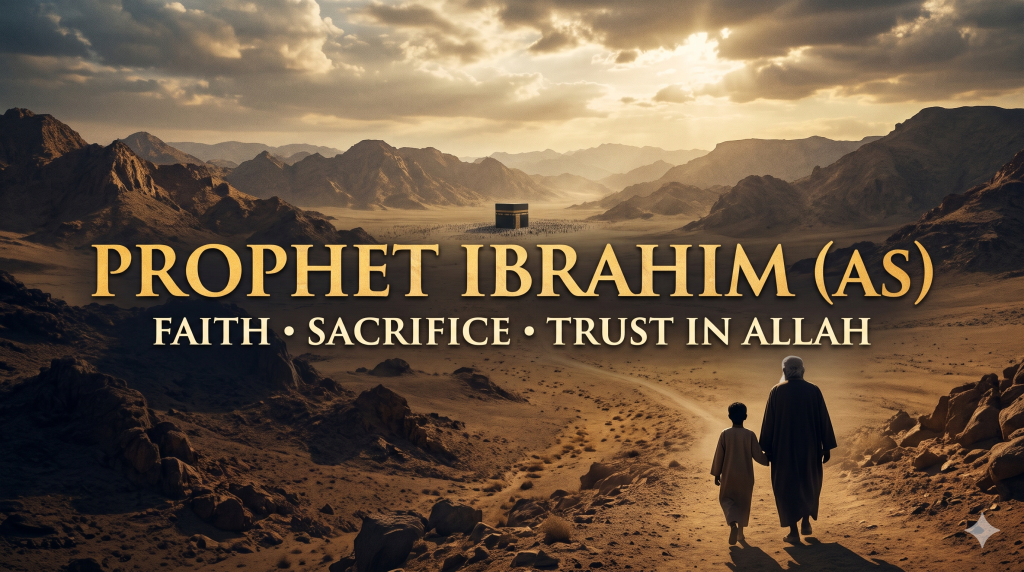
Prophet Ibrahim (AS): Faith, Sacrifice and Trust in Allah
Prophet Ibrahim (عليه السلام), known as Abraham, is one of the most honoured Prophets in Islam. His life is a remarkable example of faith, courage, patience, sacrifice and complete submission to Allah.
He challenged idol worship when his people followed false gods. He remained firm when confronted with persecution and was thrown into a fire. He left his family in a barren valley because Allah commanded him, and he willingly accepted one of the greatest tests of his life when he was commanded to sacrifice his beloved son.
The story of Prophet Ibrahim (AS) is not simply a story of historical events. It teaches us how to trust Allah, remain firm upon the truth and submit to His commands.
Let’s explore his life and the lessons the Qur’an and authentic Hadith teach us.
Is this statement true?
Myth: The Quran instructs Muslims to verify news before acting on it.
Myth: A Muslim may shorten certain prayers while travelling.
Myth: The Quran says there is no compulsion in religion.
Myth: In Islam, repentance is only accepted from someone who has never repeated a sin.
Prayer may be neglected when life is busy
Myth: The Prophet Muhammad taught that smiling at another person can count as charity.
Myth: Islam teaches that good treatment of parents is important.
Myth: Islam forbids seeking knowledge about the world.
Deeds are judged by intentions
Charity decreases a person’s wealth
Every answer includes a Quran or Sahih Hadith reference for further learning.
1. Prophet Ibrahim (AS) Challenged Idol Worship
Prophet Ibrahim (AS) lived among people who worshipped idols. Instead of accepting the beliefs of his society, he questioned their practices and called them towards the worship of Allah alone.
The Qur’an describes how he challenged his father and his people.
Surah Al-An’am (6:74)
“And [mention, O Muhammad], when Abraham said to his father Azar, ‘Do you take idols as deities? Indeed, I see you and your people to be in manifest error.'”
He also invited his people to reflect upon the stars, the moon and the sun, demonstrating that created things which rise and set cannot be worthy of worship.
Surah Al-An’am (6:76–79)
The passage concludes with Ibrahim declaring that he had turned his face towards the Creator of the heavens and the earth, remaining devoted to the truth and rejecting association with Allah.
Lesson: Faith requires sincere reflection and the courage to stand for the truth, even when society follows a different path.
2. Ibrahim (AS) Was Thrown Into the Fire
When Ibrahim (AS) challenged idol worship and exposed the falsehood of his people’s beliefs, his opponents became hostile towards him.
They decided to punish him by throwing him into a fire.
The Qur’an records what happened:
Surah Al-Anbiya (21:68–70)
They said, “Burn him and support your gods, if you are going to act.”
But Allah commanded:
“O fire, be coolness and safety upon Abraham.”
Allah protected Ibrahim (AS), and the plan of his enemies failed.
This extraordinary event demonstrates that no human power can overcome Allah’s command.
Lesson: When a believer stands firmly for the truth, Allah is capable of providing help from places and in ways that people cannot imagine.
3. Trusting Allah: Leaving Hajar and Ismail in the Barren Valley
One of the most powerful examples of trust in Allah is the incident involving Ibrahim (AS), his wife Hajar and their infant son Ismail (AS).
By Allah’s command, Ibrahim (AS) brought Hajar and their young son to a barren valley near the location of the Sacred House in Makkah.
There was no established settlement and no water supply.
He left them with a small quantity of dates and water and began to return.
Hajar followed him and asked why he was leaving them in such a place. When he did not initially respond, she asked whether Allah had commanded him to do this.
He replied that it was so.
Hajar responded with complete confidence that Allah would not abandon them.
This incident is narrated in detail by Ibn Abbas (رضي الله عنهما) in Sahih al-Bukhari 3364.
As their water was exhausted, Hajar ran between Safa and Marwah searching for help. She repeated this journey seven times. Allah then provided water through the miraculous appearance of Zamzam.
The Prophet Muhammad ﷺ explained that Hajar’s running between Safa and Marwah became the origin of the Sa’i performed by pilgrims during Hajj and Umrah.
Reference: Sahih al-Bukhari 3364.
Ibrahim’s supplication for his family is also preserved in the Qur’an.
Surah Ibrahim (14:37)
“Our Lord, I have settled some of my descendants in an uncultivated valley near Your sacred House, our Lord, that they may establish prayer. So make hearts among the people incline toward them and provide for them from the fruits that they might be grateful.”
Lesson: Tawakkul does not mean abandoning responsibility. Hajar trusted Allah while actively searching for help. Her story teaches us to combine faith with effort.
4. The Greatest Test: The Sacrifice of His Son
After years of devotion and patience, Ibrahim (AS) faced another extraordinary test.
The Qur’an describes that when his son had grown old enough to work alongside him, Ibrahim told him about a dream in which he saw himself sacrificing him.
Instead of hiding the matter, he spoke to his son.
Surah As-Saffat (37:102)
“He said, ‘O my son, indeed I have seen in a dream that I [must] sacrifice you, so see what you think.’ He said, ‘O my father, do as you are commanded. You will find me, if Allah wills, of the steadfast.'”
Both father and son demonstrated complete submission to Allah.
When they had submitted and Ibrahim laid his son down, Allah called out to him.
Surah As-Saffat (37:104–107)
Allah declared that Ibrahim had fulfilled the vision and that this was indeed a clear test.
Allah then says:
“And We ransomed him with a great sacrifice.”
The son is not named in these particular verses. The widely accepted Muslim identification is Prophet Ismail (AS).
This event is remembered through the sacrifice associated with Eid al-Adha.
Lesson: True faith means placing Allah’s commands above personal desires. Ibrahim and his son demonstrated patience, obedience and complete submission.
5. Ibrahim and Ismail Built the Ka’bah
Another remarkable event in Ibrahim’s life was the raising of the foundations of the Ka’bah with his son Ismail (AS).
Allah says:
Surah Al-Baqarah (2:127)
“And [remember] when Abraham raised the foundation of the House with Ishmael, [both praying], ‘Our Lord, accept [this] from us. Indeed, You are the Hearing, the Knowing.'”
Think about this moment: even while performing such an important act of worship, they did not become proud of their efforts. Instead, they asked Allah to accept their work.
Their supplication teaches us that the value of an action is not merely in performing it, but also in seeking Allah’s acceptance.
The detailed account of Ibrahim and Ismail building the House is also mentioned in the narration of Ibn Abbas in Sahih al-Bukhari 3364.
Lesson: Sincere worship should be accompanied by humility. We should never assume that our good deeds automatically guarantee acceptance.
6. Ibrahim (AS) Prayed for His Children and Future Generations
Prophet Ibrahim (AS) was not concerned only with his own faith. He also prayed for the guidance and righteousness of his descendants.
His beautiful supplications are preserved in Surah Ibrahim.
Surah Ibrahim (14:40)
“My Lord, make me an establisher of prayer, and [many] from my descendants. Our Lord, and accept my supplication.”
He also prayed:
Surah Ibrahim (14:41)
“Our Lord, forgive me and my parents and the believers the Day the account is established.”
These verses show the importance Ibrahim placed on prayer, family guidance and forgiveness.
He also asked Allah to protect himself and his children from idol worship.
Surah Ibrahim (14:35)
“My Lord, make this city secure and keep me and my sons away from worshipping idols.”
Lesson: A believer should pray not only for personal success but also for the faith, guidance and well-being of future generations.
7. Prophet Ibrahim’s Special Status in Islam
The Qur’an describes Ibrahim (AS) as a close friend of Allah.
Surah An-Nisa (4:125)
“And Allah took Abraham as an intimate friend.”
He is also described as an example of devotion and obedience.
Surah An-Nahl (16:120)
“Indeed, Abraham was a [comprehensive] leader, devoutly obedient to Allah, inclining toward truth, and he was not of those who associate others with Allah.”
His life established an enduring example of Tawheed, sincere worship and submission to Allah.
8. Important Lessons We Can Learn From Prophet Ibrahim (AS)
The life of Ibrahim (AS) offers guidance for every generation.
1. Believe in Allah alone
He rejected idol worship and called people towards Tawheed. Our worship and ultimate reliance should be directed to Allah alone.
2. Stand firm upon the truth
He did not abandon his beliefs because of opposition or threats.
3. Trust Allah during difficult times
His family was left in a barren valley, but he trusted Allah’s command and care.
4. Combine Tawakkul with effort
Hajar’s search for water teaches us that trusting Allah does not mean remaining inactive.
5. Be willing to sacrifice for Allah
The test of sacrifice demonstrates the importance of sincere submission and obedience.
6. Remain humble in worship
Even after building the Ka’bah, Ibrahim and Ismail asked Allah to accept their work.
7. Pray for your family
Ibrahim’s duas remind us to seek guidance and righteousness for our children and future generations.
Conclusion: A Life Built on Faith and Submission
The story of Prophet Ibrahim (AS) teaches us that true faith is demonstrated through actions, patience and complete trust in Allah.
He challenged false beliefs, endured persecution, trusted Allah with his family, accepted the test of sacrifice and helped raise the foundations of the Ka’bah.
His life reminds us that difficulties do not mean Allah has abandoned us. Sometimes the greatest tests become the means through which faith, patience and devotion are demonstrated.
Let us learn from his example and strengthen our relationship with Allah through sincere worship, patience, trust and obedience.
May Allah grant us the faith of Ibrahim, the patience to face our trials, the sincerity to perform good deeds and the ability to place our complete trust in Him. Ameen.
—
Watch More Islamic Educational Videos
Explore more stories of the Prophets and Islamic knowledge based on authentic Qur’anic verses and Hadith on SK Global Lens.
Next -> Prophet Ayyub (AS): The Story of Patience in Illness
Watch the related video: https://www.youtube.com/@skgloballens
Visit: https://skgloballens.com/
*SK Global Lens — Discover the Truth Behind Every Story.*