In this article
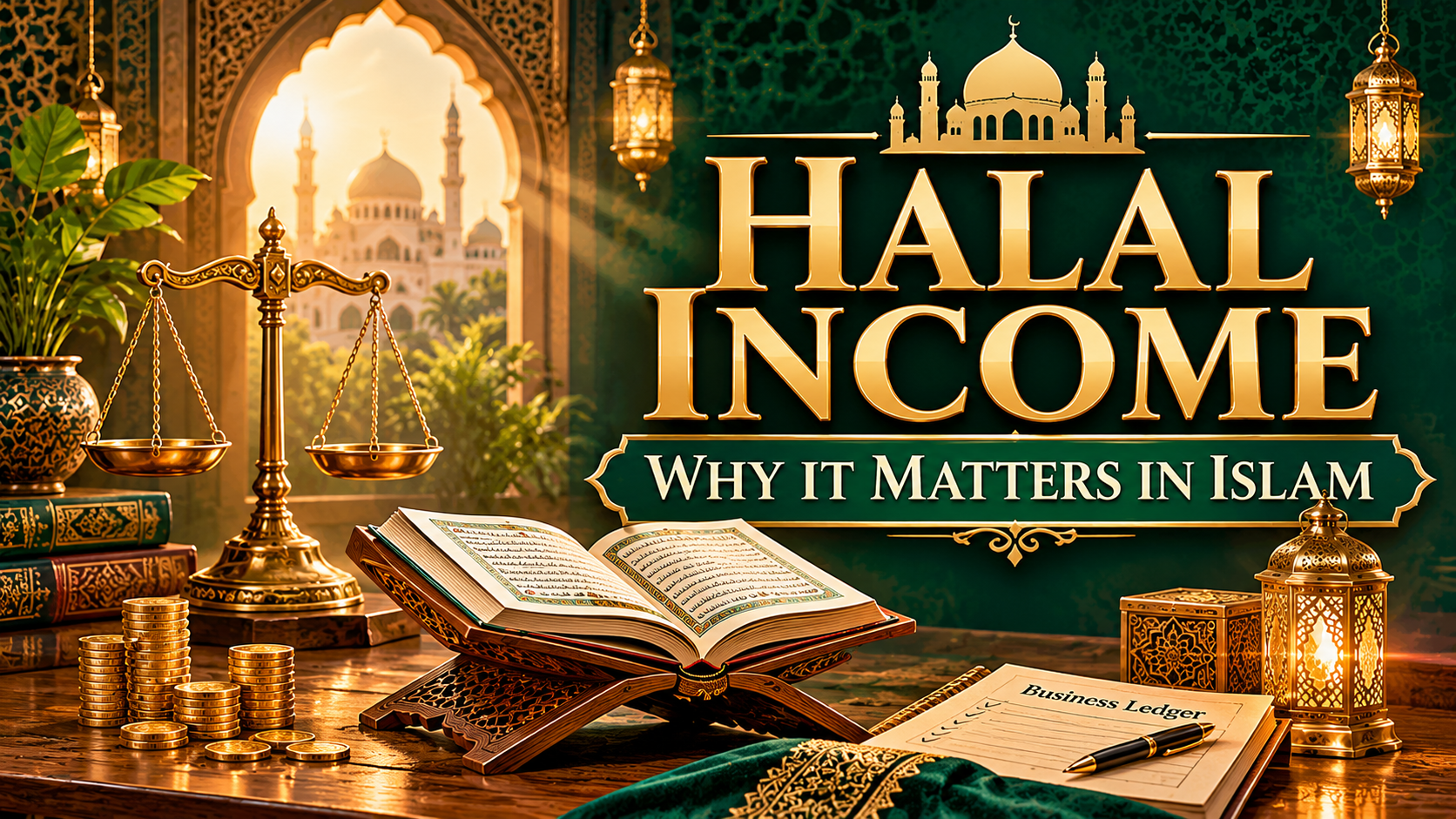
Halal Income and Why It Matters in Islam
Earning a living is an important part of everyday life. Every person works to provide food, clothing, shelter, education, and other necessities for themselves and their family. However, Islam teaches that earning money is not just about making a living; it is also about choosing the right and lawful way to earn it.
In Islam, lawful income is known as Halal Rizq. Muslims are encouraged to earn through honest work, fair business, and permissible sources while avoiding fraud, deception, exploitation, and prohibited financial activities.
The Holy Quran and the teachings of Prophet Muhammad ﷺ repeatedly emphasise the importance of consuming what is lawful and pure.
But what exactly is Halal income? Why does it matter? What types of earnings are considered Haram? And how can Muslims ensure that their daily income is earned according to Islamic principles?
Let’s explore these questions through authentic Islamic teachings.
1. What Is Halal Income in Islam?
Halal income refers to money earned through lawful and permissible activities according to Islamic teachings.
The Arabic word *Halal* means permissible or lawful, while *Haram* means forbidden or prohibited.
Islam encourages Muslims to earn their livelihood through honest effort, useful services, ethical business, and fair transactions.
Examples of Halal income include:
– Salary earned through permissible employment.
– Income from a lawful business.
– Profits from honest buying and selling.
– Earnings from freelancing and professional services.
– Income from farming and agriculture.
– Money earned through teaching and other beneficial services.
– Rental income from permissible properties and activities.
However, the nature of the work is not the only consideration. The method of earning must also be lawful.
For example, selling a permissible product through deception, false advertising, or fraudulent practices can make the transaction sinful.
Islam encourages both lawful sources of income and honest methods of earning.
2. What Does the Quran Say About Halal Earnings?
The Holy Quran clearly instructs humanity to consume what is lawful and good.
Allah says:
“O mankind, eat from whatever is on earth [that is] lawful and good and do not follow the footsteps of Satan. Indeed, he is to you a clear enemy.”
Surah Al-Baqarah (2:168)
This verse highlights two important principles:
– Halal: What is permitted according to Islamic teachings.
– Tayyib: What is good, wholesome, and pure.
Allah also instructs believers specifically:
“O you who have believed, eat from the good things which We have provided for you and be grateful to Allah if it is [indeed] Him that you worship.”
Surah Al-Baqarah (2:172)
These verses remind Muslims that their food, livelihood, and financial activities should be connected to gratitude and obedience to Allah.
3. Why Is Halal Income Important in Islam?
Halal income is important because a Muslim’s financial activities are part of their religious responsibilities.
Earning money through lawful means reflects honesty, responsibility, and obedience to Allah.
Here are some important reasons why Halal income matters.
A. It Is an Act of Obedience to Allah
Choosing lawful earnings means respecting the boundaries established by Allah.
Muslims are encouraged to work hard while avoiding prohibited sources of wealth.
B. It Brings Barakah into Life
Barakah means blessing or goodness granted by Allah.
A person’s wealth is not measured only by how much money they possess. Its benefit, peace, usefulness, and the good it enables are also important.
A lawful income earned honestly allows a Muslim to seek Allah’s blessings in their livelihood.
C. It Supports a Peaceful Family Life
When a person earns through permissible means, they can provide for their family while fulfilling their responsibilities.
Providing lawful food, clothing, education, and shelter is an important part of family responsibility.
D. It Protects People from Injustice
Islam prohibits earning money through fraud, theft, exploitation, bribery, and unfair transactions.
Honest earning protects the rights of customers, employees, business partners, and society.
E. It Is Connected to the Acceptance of Duas
In an authentic Hadith, Prophet Muhammad ﷺ described a traveller who raises his hands and calls upon Allah, but his food, drink, clothing, and nourishment are unlawful.
The Prophet ﷺ then asked how such a person’s supplication could be answered.
Reference: Sahih Muslim 1015.
This Hadith highlights the serious spiritual importance of lawful consumption and earning.
F. It Prepares Muslims for Accountability in the Hereafter
Muslims believe that they will be questioned about their actions, including their financial dealings.
Prophet Muhammad ﷺ taught that a person’s feet will not move on the Day of Judgment until they are questioned about their wealth, including how it was earned and spent.
Reference: Jami’ at-Tirmidhi 2417 (reported in the Hadith of the Day of Judgment).
4. What Are the Sources of Haram Income in Islam?
Islam identifies certain activities and financial practices as prohibited.
Muslims should be careful to avoid earning money through unlawful sources.
Some important examples include:
A. Riba (Interest)
Riba refers to prohibited interest or usury.
The Quran clearly distinguishes lawful trade from Riba.
Allah says:
“Allah has permitted trade and has forbidden interest.”
Surah Al-Baqarah (2:275)
Muslims should be careful about interest-based financial transactions and seek qualified Islamic guidance when dealing with complex financial products.
B. Gambling and Betting
Income earned through gambling and betting is prohibited.
This includes activities such as:
– Gambling for money.
– Betting on sports.
– Casino gambling.
– Lottery and betting schemes involving prohibited wagering.
Quranic Reference: Surah Al-Ma’idah (5:90–91).
C. Fraud and Deception
Making money through lies, cheating, fake promises, or dishonest business practices is prohibited.
Examples include:
– Selling counterfeit products as genuine.
– Hiding important product defects.
– Using fake reviews to deceive customers.
– Creating false invoices.
– Misrepresenting services to obtain payment.
Quranic Reference: Surah Al-Baqarah (2:188).
D. Bribery and Corruption
Bribery involves offering or receiving money or benefits to obtain an improper advantage.
Islam prohibits consuming wealth unjustly and using corrupt practices to take what does not rightfully belong to someone.
E. Theft and Misappropriation
Taking another person’s money, property, or business assets without permission is unlawful.
This includes stealing from employers, customers, business partners, and individuals.
F. Selling Prohibited Products or Services
Income generated from activities directly involving prohibited products or services is also a serious Islamic concern.
Examples include trading in intoxicants and facilitating gambling.
Quranic Reference: Surah Al-Ma’idah (5:90).
5. Halal Income for Employees and Salaried Workers
Halal income is not only important for business owners and traders. It is equally important for employees and salaried professionals.
Whether someone works in an office, school, hospital, factory, or technology company, they should ensure that their work and earnings are permissible.
Here are some practical principles:
1. Perform assigned responsibilities honestly.
2. Do not submit false working hours or attendance records.
3. Avoid stealing company resources or confidential information.
4. Do not accept money for dishonest favours.
5. Complete work according to agreed responsibilities.
6. Avoid knowingly participating in fraudulent activities.
7. Respect employment agreements and the rights of colleagues.
A salary earned through genuine work and a permissible job is generally lawful.
However, if a person’s role directly involves prohibited activities, the specific circumstances may require guidance from a qualified Islamic scholar.
6. Halal Income in Business and Trade
Islam encourages lawful trade and honest business.
A Muslim business owner should treat customers, suppliers, employees, and business partners fairly.
Important Islamic business principles include:
– Provide accurate information about products.
– Do not manipulate weights or measurements.
– Avoid false advertising.
– Honour agreements and commitments.
– Pay employees fairly and on time.
– Disclose important defects in products.
– Avoid dishonest pricing practices.
– Do not exploit customers or suppliers.
– Maintain transparency in financial transactions.
Allah says:
“And give full measure when you measure, and weigh with an even balance. That is the best [way] and best in result.”
Surah Al-Isra (17:35)
Prophet Muhammad ﷺ also encouraged honesty and kindness in business transactions.
Hadith Reference: Sahih al-Bukhari 2076.
A successful Muslim business should not focus only on profit. It should also protect trust, fairness, and the rights of others.
7. Halal Income in the Digital World
Today, many people earn money through the internet, freelancing, social media, websites, online businesses, and digital marketing.
These modern earning opportunities can be permissible when the underlying work, products, services, and financial arrangements comply with Islamic principles.
Some examples include:
Freelancing
Earning through web development, graphic design, writing, programming, and other permissible professional services can be Halal.
Blogging and Websites
Income from advertisements, sponsored content, and affiliate marketing can be permissible when the promoted products and services are lawful and the agreements are transparent.
YouTube and Social Media
Content creation and monetisation can be permissible when the content and associated income sources comply with Islamic guidelines.
E-Commerce
Selling lawful products online through honest descriptions, transparent pricing, and fair transactions is a permissible business model.
Online Teaching
Teaching useful subjects, professional skills, and educational courses can provide lawful income.
Important: Digital income should be evaluated according to its actual source and activities. Not every online earning method is automatically Halal. Particular cases involving advertisements, financial products, affiliate commissions, sponsorships, and platform monetisation may require individual scholarly assessment.
8. What Is the Difference Between Halal and Haram Income?
Understanding the difference helps Muslims make better financial decisions.
| Halal Income | Haram Income |
| Honest employment | Fraudulent employment |
| Lawful business profits | Profits from prohibited activities |
| Genuine freelancing | Payment for deceptive services |
| Fair buying and selling | Cheating customers |
| Permissible rental income | Rental for prohibited activities |
| Transparent transactions | Bribery and corruption |
| Lawful investments | Interest-based or otherwise prohibited investments |
The important principle is that money should be earned through permissible activities without violating the rights of others.
9. What Should a Muslim Do If They Discover Their Income Is Haram?
Sometimes people discover that a source of income or a financial transaction may not comply with Islamic teachings.
In such situations, they should take the matter seriously and seek a responsible solution.
Some practical steps include:
1. Identify the exact source of the questionable income.
2. Stop participating in clearly prohibited activities.
3. Seek guidance from a qualified Islamic scholar.
4. Understand whether any money or property must be returned to its rightful owner.
5. Correct financial arrangements where possible.
6. Repent sincerely and ask Allah for forgiveness.
7. Make a genuine effort to move towards lawful earning.
The treatment of previously earned money depends on the circumstances, the nature of the transaction, and the rights of other people. It is important not to make blanket assumptions about every situation.
Allah is Most Merciful and accepts sincere repentance.
10. How Can Muslims Increase Barakah in Their Income?
Barakah is one of the greatest blessings a Muslim can seek.
It is not necessarily about earning more money. It is about receiving goodness and benefit from what Allah provides.
Here are some practical ways to seek Barakah in your livelihood:
1. Earn through lawful sources.
2. Speak the truth in business and employment.
3. Maintain regular Salah.
4. Give Zakat when it becomes obligatory.
5. Give voluntary Sadaqah.
6. Avoid cheating and dishonesty.
7. Fulfil promises and agreements.
8. Treat employees and customers fairly.
9. Express gratitude to Allah.
10. Make Dua for lawful and beneficial provision.
Allah says:
“And whoever fears Allah – He will make for him a way out. And will provide for him from where he does not expect.”
Surah At-Talaq (65:2–3).
This verse reminds believers to maintain Taqwa and trust Allah’s provision.
11. A Beautiful Dua for Halal Rizq
Muslims can ask Allah for lawful provision, independence from unlawful earnings, and contentment with His blessings.
One authentic supplication reported from Prophet Muhammad ﷺ is:
Arabic:
اللَّهُمَّ اكْفِنِي بِحَلَالِكَ عَنْ حَرَامِكَ، وَأَغْنِنِي بِفَضْلِكَ عَمَّنْ سِوَاكَ
Transliteration:
Allahummak-fini bi halalika ‘an haramika, wa aghnini bi fadlika ‘amman siwaka.
Meaning:
“O Allah, suffice me with what You have made lawful instead of what You have made unlawful, and make me independent by Your grace of all others besides You.”
Reference: Jami’ at-Tirmidhi 3563.
This Dua is a beautiful reminder to seek lawful provision and depend upon Allah.
Frequently Asked Questions (FAQs)
1. What is Halal income in Islam?
Halal income is money earned through lawful and permissible activities according to the Quran and Sunnah, without fraud, exploitation, or prohibited financial practices.
2. Is earning a salary Halal in Islam?
Yes. Earning a salary is generally permissible when the work itself is lawful, the employment agreement is valid, and the employee fulfils their responsibilities honestly.
3. Is online earning Halal?
Online earning can be Halal when the work, products, services, advertising, and financial arrangements comply with Islamic principles.
4. Is business profit Halal?
Yes. Islam permits lawful trade and business profits. However, transactions must avoid Riba, fraud, deception, prohibited products, and injustice.
5. Why does Islam prohibit Haram income?
Islam prohibits unlawful income to protect faith, property, human rights, fairness, and society from exploitation and corruption.
6. Does Halal income bring Barakah?
Muslims seek Barakah through lawful earning, Taqwa, gratitude, charity, and obedience to Allah. Barakah is a blessing from Allah and should not be measured only by financial wealth.
7. Can a Muslim earn money through YouTube and affiliate marketing?
These methods can be permissible when the content, products, advertisements, commissions, and business arrangements are lawful and transparent. Individual cases may require scholarly guidance.
8. What is the best Dua for Halal Rizq?
The supplication beginning with “Allahummak-fini bi halalika ‘an haramika” is an authentic Dua reported in Jami’ at-Tirmidhi 3563.
Conclusion
Halal income is much more than a financial responsibility in Islam. It is an important part of a Muslim’s faith, character, and relationship with Allah.
Whether someone is an employee, business owner, freelancer, farmer, or online entrepreneur, the same principle applies: earn honestly, avoid prohibited activities, respect the rights of others, and remain grateful for what Allah provides.
Wealth earned through lawful means can become a source of goodness when it is used responsibly to support families, help others, give charity, and fulfil religious obligations.
Remember, success is not simply about how much money we earn. It is also about how we earn it and how we use it.
May Allah bless our earnings, protect us from Haram Rizq, grant us Halal and Tayyib provision, and place Barakah in our homes and families. Ameen.
Continue Learning with SK Global Lens
Explore more authentic Islamic knowledge, Quranic teachings, daily Duas, Sunnah practices, and Islamic guidance at SK Global Lens.
Learn Islam through authentic references from the Holy Quran and Sahih Hadith.