In this article
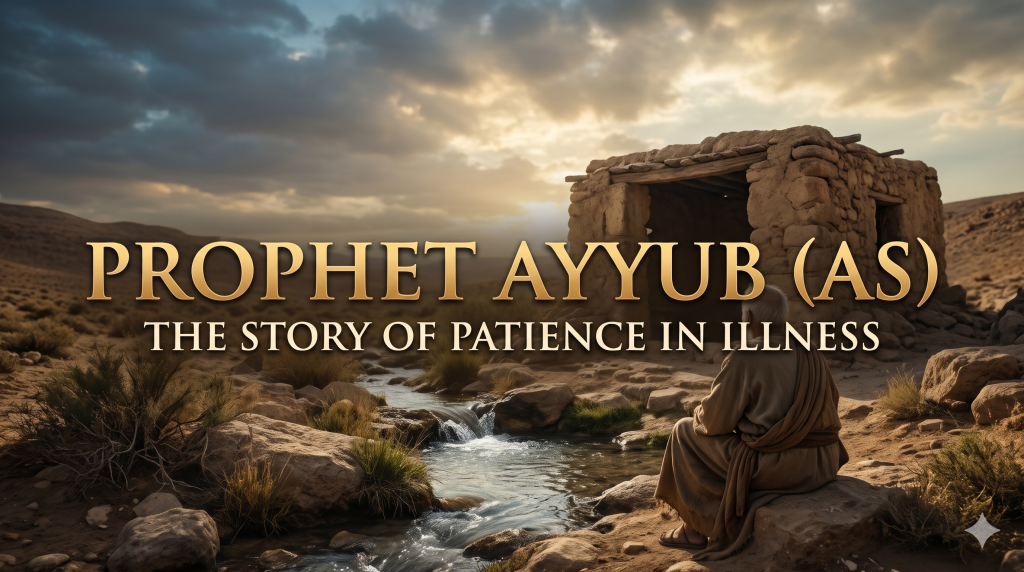
Prophet Ayyub (AS): The Story of Patience in Illness
Prophet Ayyub (عليه السلام), known as Job, is one of the greatest examples of patience and faith in Islamic history. His life teaches us how to remain connected to Allah during illness, hardship and difficult circumstances.
He experienced severe adversity, yet he never abandoned his trust in Allah. Instead of turning away from his Creator, he called upon Him with humility and acknowledged His mercy.
The Qur’an describes how Allah answered his supplication, removed his suffering and restored His blessings.
The story of Prophet Ayyub (AS) is a powerful reminder that hardship is not necessarily a sign of Allah’s displeasure and that a believer should never lose hope in His mercy.
Let’s explore his story and the important lessons it teaches us through the Qur’an and authentic Hadith.
1. Prophet Ayyub (AS): A Servant of Exceptional Patience
Allah mentions Prophet Ayyub (AS) among His righteous servants and describes him as an excellent servant who constantly turned back to Him.
His story appears in two important passages:
– Surah Al-Anbiya (21:83–84)
– Surah Sad (38:41–44)
These verses describe his suffering, his supplication, Allah’s response and his restoration.
The Qur’an does not provide a detailed medical description of his illness or specify how many years he suffered. Therefore, we should avoid presenting popular historical details as established facts without reliable evidence.
What Allah has clearly revealed is enough to understand the greatness of his patience and devotion.
Is this statement true?
Deeds are judged by intentions
Myth: The Prophet Muhammad taught that smiling at another person can count as charity.
Myth: Islam teaches that good treatment of parents is important.
Myth: Muslims must give charity only during Ramadan.
Charity decreases a person’s wealth
Myth: The Quran instructs Muslims to verify news before acting on it.
Myth: Missing a fast intentionally has no religious consequence if it is made up later.
Myth: Islam forbids seeking knowledge about the world.
Myth: The Quran says there is no compulsion in religion.
Myth: A Muslim may shorten certain prayers while travelling.
Every answer includes a Quran or Sahih Hadith reference for further learning.
2. The Difficult Trial of Prophet Ayyub (AS)
Prophet Ayyub (AS) was tested with severe hardship and suffering.
Allah says:
Surah Sad (38:41)
“And remember Our servant Job, when he called to his Lord, ‘Indeed, Satan has touched me with hardship and torment.'”
The verse describes the distress and suffering he experienced.
In Surah Al-Anbiya, Allah also mentions his adversity:
Surah Al-Anbiya (21:83)
“And [mention] Job, when he called to his Lord, ‘Indeed, adversity has touched me, and You are the Most Merciful of the merciful.'”
These verses show that even a righteous Prophet can experience severe physical and personal hardship.
His suffering did not make him abandon his faith. He continued turning towards Allah.
Lesson: Experiencing illness or hardship does not automatically mean that Allah is displeased with a person. Difficulties can be tests, and a believer should continue seeking Allah’s mercy.
3. The Beautiful Dua of Prophet Ayyub (AS)
One of the most inspiring parts of his story is the way he called upon Allah.
Instead of complaining with arrogance or losing hope, he acknowledged his suffering and praised Allah’s mercy.
His supplication is recorded in the Qur’an:
Arabic:
رَبِّ أَنِّي مَسَّنِيَ الضُّرُّ وَأَنْتَ أَرْحَمُ الرَّاحِمِينَ
Transliteration:
Rabbi anni massaniyad-durru wa anta arhamur-rahimeen.
Meaning:
“My Lord, indeed adversity has touched me, and You are the Most Merciful of the merciful.”
Reference: Surah Al-Anbiya (21:83).
This short but powerful supplication teaches us several things:
– Acknowledge your difficulties before Allah.
– Ask Him for help with humility.
– Remember that His mercy is greater than every hardship.
– Never lose hope in His power to change your circumstances.
This is a Qur’anic dua of Prophet Ayyub (AS). Muslims can recite it when facing illness, distress or other difficulties, asking Allah for relief and mercy.
4. Allah Answered His Dua and Removed His Suffering
After mentioning Ayyub’s supplication, Allah describes His response.
Surah Al-Anbiya (21:84)
“So We responded to him and removed what afflicted him of adversity. And We gave him back his family and the like thereof with them as mercy from Us and a reminder for the worshippers.”
What a powerful reminder!
The same Allah who tests His servants has complete power to remove their difficulties.
Allah restored Ayyub’s well-being and granted him His mercy.
The passage concludes by reminding worshippers of the lesson in this event.
This teaches us that we should never assume our present circumstances will remain unchanged forever. Allah knows what we are experiencing and is fully capable of bringing relief.
However, we should also remember that Allah’s response to dua does not always happen in the way or at the time we expect. Our responsibility is to keep asking Him, remain patient and continue doing what is right.
5. Allah Provided Water for Ayyub (AS)
Surah Sad provides another detail about Allah’s mercy towards Prophet Ayyub (AS).
Allah says:
Surah Sad (38:42)
“[We said], ‘Strike [the ground] with your foot; this is a spring for a cool bath and drink.'”
Allah directed Ayyub (AS) to strike the ground with his foot, and provided water for him to bathe and drink.
The following verse describes the restoration of his family and blessings.
Surah Sad (38:43)
“And We granted him his family and a like [number] with them as mercy from Us and a reminder for those of understanding.”
This passage demonstrates Allah’s power, mercy and ability to restore what has been lost.
It also reminds us that relief can come through means that we could never have anticipated.
6. Allah Praised Ayyub’s Patience
Perhaps the most powerful statement about Prophet Ayyub (AS) appears in Surah Sad.
Allah says:
Surah Sad (38:44)
“Indeed, We found him patient. An excellent servant! Indeed, he was one repeatedly turning back [to Allah].”
Think about the honour Allah gave him.
Allah Himself praised Ayyub (AS) for his patience and described him as an excellent servant.
His patience was not simply remaining silent during suffering. It was maintaining faith, continuing to turn towards Allah and refusing to abandon his relationship with his Creator.
This is the essence of Sabr in Islam.
Lesson: True patience means remaining steadfast in faith during difficult circumstances while continuing to seek Allah’s help and mercy.
7. A Beautiful Hadith About Prophet Ayyub (AS)
The Prophet Muhammad ﷺ also narrated an incident from the life of Ayyub (AS).
Abu Hurairah (رضي الله عنه) reported that the Messenger of Allah ﷺ said:
“While Job was naked, taking a bath, a swarm of gold locusts fell on him and he started collecting them in his garment.”
Allah called out to him, asking whether He had not already made him wealthy enough to be independent of what he was collecting.
Ayyub replied:
“Yes, O Lord! But I cannot dispense with Your blessing.”
Reference: Sahih al-Bukhari 3391.
This authentic Hadith highlights Ayyub’s gratitude and recognition that every blessing comes from Allah.
Even after his suffering had been removed and his blessings restored, he remained grateful and valued Allah’s blessings.
Lesson: Never become so accustomed to your blessings that you forget the One who provided them. Gratitude should remain part of a believer’s life in both hardship and ease.
8. Important Lessons From the Story of Prophet Ayyub (AS)
The story of Ayyub (AS) offers timeless guidance for every Muslim.
1. Never lose hope in Allah
No matter how difficult your circumstances become, Allah’s mercy is greater than your hardship.
2. Make dua during illness
Ayyub (AS) turned towards Allah and asked for His mercy. We should also make sincere supplications when facing difficulties.
3. Be patient during trials
Patience is an important quality of a believer. It helps us remain firm in faith when life becomes difficult.
4. Remember Allah during both hardship and ease
Do not remember Allah only when you need something. Maintain your connection with Him at all times.
5. Be grateful for every blessing
The Hadith in Sahih al-Bukhari 3391 reminds us of Ayyub’s gratitude even after his recovery.
6. Do not judge people facing illness
Illness is not proof that someone has committed a particular sin or that Allah has abandoned them. Every person’s circumstances are known fully only to Allah.
7. Combine patience with practical effort
Seeking medical treatment, following appropriate advice and taking care of one’s health are compatible with trusting Allah. Tawakkul does not require abandoning available means of help.
Conclusion: Patience Opens the Door to Hope
The story of Prophet Ayyub (AS) reminds us that even the most righteous servants of Allah can experience severe hardship.
His life teaches us to remain patient, make sincere dua, trust Allah’s mercy and never allow suffering to destroy our faith.
When illness or difficulties enter our lives, remember the words of Ayyub (AS):
Rabbi anni massaniyad-durru wa anta arhamur-rahimeen.
“My Lord, indeed adversity has touched me, and You are the Most Merciful of the merciful.”
Let us learn from his example and continue turning towards Allah in every situation.
May Allah grant patience to those who are suffering, provide healing to the sick, ease the difficulties of those facing hardship and strengthen our faith in every test. Ameen.
—
Watch More Islamic Educational Videos
Discover more inspiring stories of the Prophets and Islamic knowledge based on authentic Qur’anic verses and Hadith on SK Global Lens.
Next -> Prophet Ibrahim (AS): Faith, Sacrifice and Trust in Allah
Watch the related video: https://www.youtube.com/@skgloballens
Visit: https://skgloballens.com/
*SK Global Lens — Discover the Truth Behind Every Story.*